When his father was governor, California was awash in federal highway dollars. Now Jerry Brown's administration contemplates a risky tax hike, juggling the need for road improvements with a clean, transit-oriented agenda.


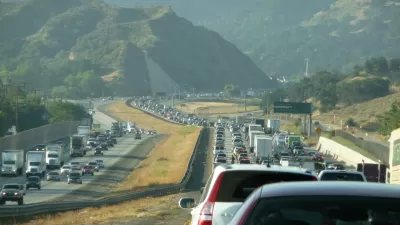
More than a little historical irony accompanies California's newest budgetary predicament. "After years of neglect, state officials estimate it will cost $59 billion to fix the now-crumbling roads and freeways that Gov. Edmund G. 'Pat' Brown championed more than five decades ago. And it's up to his son, Gov. Jerry Brown, to find the money."
Pat Brown's mid-century administration benefited from abundant federal money for new roads and highways. Now, federal transportation funding is drying up while an explosion of efficient cars has hobbled the state gas tax.
But more taxes are the only clear solution. "[T]he governor recently called a special legislative session to focus lawmakers' attention on the problems with roads, and a hearing is scheduled for Thursday. The result could be new fees and taxes for drivers — a politically charged scenario in a state with a celebrated romance with the automobile." Auto-related taxes are often politically toxic in California. But this time, business may be willing to stomach a tax hike for the sake of better roads.
Gov. Brown's administration is caught between its stated environmental priorities—including high-speed rail—and an auto infrastructure behemoth reaching deep into the state's coffers.
Read the full story: Gov. Brown faces rough road in quest to repair state freeways

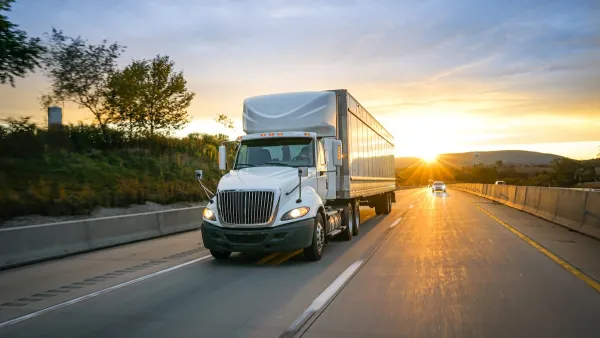
How a Truck Tax Could Save the Highway Trust Fund
The freight trucking industry is a prime candidate for a mileage tax that would boost road maintenance revenue.
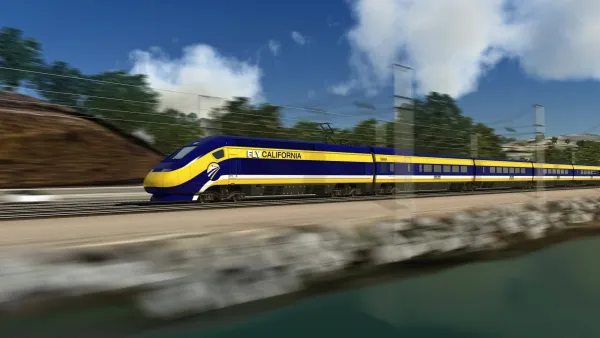
Proposed California Ballot Measure From Gas Tax Opposition Goes After High-Speed Rail
A follow-up initiative to Proposition 6 would put the brakes on high-speed rail in California and funnel gas tax funds to roads.
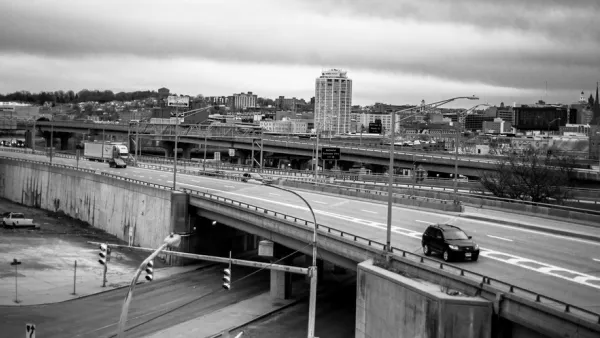
America's Infrastructural Reckoning
Through the lens of Henry Petroski's new book, Tom Vanderbilt discusses why infrastructure, as we have come to define it, is such a fraught topic in American life.

Planetizen Federal Action Tracker
A weekly monitor of how Trump’s orders and actions are impacting planners and planning in America.

Amtrak, CN end decades-long dispute with eight-year agreement
The new operating agreement establishes an updated framework for the companies to work together, including processes to resolve disputes.

Judges permit Denver to divert 77,000 acre feet from the Colorado River for reservoir expansion
Overuse and climate change have caused the Colorado River’s water levels to plummet.

Boston has spent millions making the Green Line more accessible — and there’s no end in sight
While the city has invested millions into expanding and adding platforms to the Green Line to make it more accessible, new train cars set to arrive next year will be too tall for disabled passengers to board without raising the current platforms.

Idaho may see an 18% drop in federal surface transit funding — the largest estimated cut in the US
Transit systems in rural communities are much more reliant on federal funding to provide their services.

How ‘post-disaster gentrification’ alters neighborhoods after natural calamities
After hurricanes, fires or other calamities, the original residents of a community are often replaced by younger, wealthier residents.

FREE Course: Walkable City 1: Why Walkability?
After describing his path towards focusing on walkability as the essence of good planning, Jeff Speck marches through his five principal reasons for making more walkable places.
Reinventing Malls: Planning Alchemy—Turning Gray Fields Into Gold
The course focuses on the opportunities and imperatives that shape reinvention of mall sites.

City of Wisconsin Rapids
Harvard University Graduate School of Design
KFH Group Inc.
The Architects Foundation
University of Cincinnati Online
The Pocatello Development Authority
The Urban Renewal Agency of the City of Pocatello