Long considered a roadblock to raising the revenues necessary to run California, Prop. 13 is one of the country's most notorious political third rails. Two state senators, however, would roll back Prop 13 protections for commercial properties.


"Two Democratic state senators plan to introduce legislation Wednesday to overhaul Proposition 13, the state's landmark restrictions on property taxes, so local governments can raise more revenue from commercial and industrial properties," reports Chris Megerian.
"The measure would allow for regular reassessments of offices, factories and other buildings, ensuring that they are taxed at closer to current market value. Currently they're reassessed only when there's a change in ownership."
The measure would require approval on the statewide ballot in November 2016. The article by Megerian provides a lot more detail on the tough political battle the measure faces to make it through the legislature and gain approval from the state's voters.
Sens. Loni Hancock (D-Berkeley) and Holly Mitchell (D-Los Angeles) authored the measure, and have also penned on op-ed for the Sacramento Bee calling for reforms to make Prop. 13 fair for homeowners. The crux of that argument: "because of a structural flaw in Proposition 13, big businesses and wealthy commercial landowners are able to take advantage of the same tax protections that were intended to benefit California’s homeowners and renters. Some have even used the law to structure themselves in ways that mean they will never have to pay taxes on the fair value of their land."
Read the full story: California state senators to propose overhaul of Prop. 13

California's 'Split Roll' Property Tax Reform, Explained
California voters will consider a landmark reform of its infamous property tax system this November. Prop. 15 would remove property tax caps on commercial properties established by Prop. 13 in 1978.
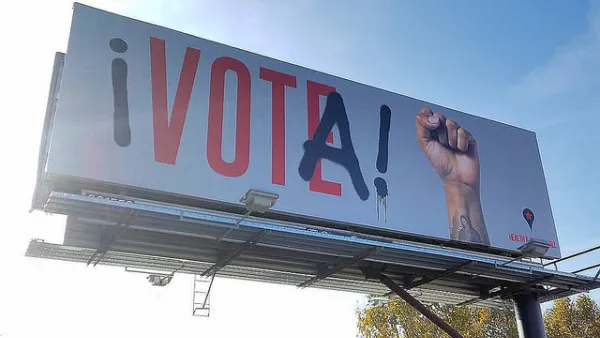
Prop 13 on the Ballot in California—Just Not the Prop 13 Everyone's Worried About
A case of mistaken identity has embroiled California in election controversy, as claims of bias and misinformation swirl around Prop 13 (2020), Prop 13 (1978), and an anticipated "split roll" initiative.

California Prepares for a Prop. 13 Showdown
Expect property tax reform to be in the news in 2019.

Planetizen Federal Action Tracker
A weekly monitor of how Trump’s orders and actions are impacting planners and planning in America.

California plans to bury El Niño’s downpour
If the state plays its cards right, it may be able to store a billion acre-feet of El Niño’s water in aquifers.

Desperate measures: Advocates weigh draining Lake Powell to fill Colorado River
Draining the reservoir could reduce evaporation losses by a couple hundred thousand acre-feet.

US buildings threatened, destroyed by fires set to triple by 2060
Researchers found a high fire risk for socioeconomically vulnerable neighborhoods in the American West.

LA residents may be allowed to paint their own crosswalks
Councilwoman Katy Yaroslavsky put out a motion instructing the Los Angeles Department of Public Transportation to study the feasibility of allowing volunteers to paint crosswalks.

Dallas moves to overhaul its zoning code
The city's zoning reform will allow more multi-family and mixed-use developments.

FREE Course: Walkable City 1: Why Walkability?
After describing his path towards focusing on walkability as the essence of good planning, Jeff Speck marches through his five principal reasons for making more walkable places.
Reinventing Malls: Planning Alchemy—Turning Gray Fields Into Gold
The course focuses on the opportunities and imperatives that shape reinvention of mall sites.

City of Rosemead
Rutgers University, Edward J. Bloustein School of Planning and Public Policy
One Hundred Miles
Hunter College, City University of New York (CUNY)
The Architects Foundation
University of Cincinnati Online
City of Cambridge
Montrose County
The Pocatello Development Authority