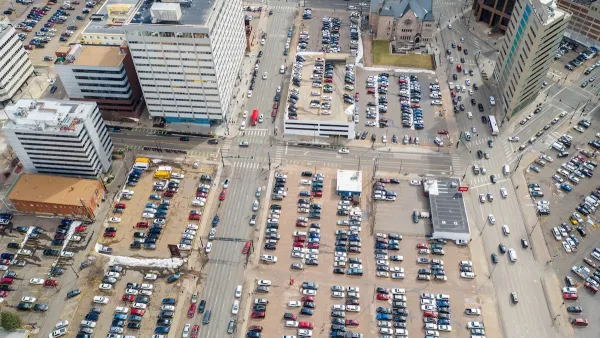
At the edge of the Great Plains, Denver would seem to have plenty of room for everything, including parking. But a development boom in downtown Denver has reduced the number of parking lots, and the city is learning to evolve.



Pretty much every new building in and around downtown Denver -- and there are a lot of them -- was built on the site of a former parking lot. While the city's planners, developers, and young residents applaud this trend, it has led to the unintended consequence of tighter parking for the commuters, and some residents, who rely on cars to get in and out of the city's business district. Some auto-oriented commuters, who make up 43 percent of the downtown workforce, who were long accustomed to their lots have arrived at work to find bulldozers where their parking spaces used to be.
The laws of supply and demands are in full effect, as the cost of parking rises while supply drops. Some of the salient statistics include:
- The total number of parking spaces has dropped from a high of 43,766 in 2010 to 42,009 today.
- Daily rates for surface parking lots have risen from $7 in 2010 to $9 today.
- Monthly rates have gone from $115 to $122 in the same period.
"As surface parking lots go away, downtown becomes much more inviting and walkable," Ken Schroeppel, an instructor of planning and design at the University of Colorado Denver, told the Denver Post. "We used to be a car-oriented cowtown that looked at parking as a fundamental right. But now, as a big city, we shouldn't always expect to find cheap and easy parking downtown."
FULL STORY: Downtown Denver's development boom adds vibrancy, subtracts parking


Denver mayor pushes for cheap downtown parking, says promoting transit is 'not our strategy'
The 'Mayor's Park $5' program encourages local businesses to reduce their parking prices to bring more people downtown.
Study: Eliminating Parking Requirements Would Boost Denver Housing by 12.5%
Denver and other Colorado cities have recently reduced or eliminate parking requirements, paving the way to more affordable housing development.
Denver Could Eliminate Parking Requirements
The city could remove parking mandates citywide to reduce the cost of housing construction and ease permitting for new projects.

The state-sanctioned urbicide of Austin
People don’t kill cities. Freeways do.

US to reduce Colorado River water deliveries to Mexico
A new Colorado Treaty amendment reduces Mexico’s Colorado River water allocation by 250,000 acre feet.

New Jersey’s second-largest city bans standalone data centers
Jersey City will continue to allow co-location facilities, such as those meant for research institutions that store their own data.

Amtrak not solely to blame for New Jersey commuter rail's unreliability, report finds
A new study from the Garden State Initiative found that NJ Transit’s budget grew 20% across a 4 year period, but reliability declined significantly over the same period.

EPA erases limits on planet-warming pollution from power plants
Under Monday’s plan, power plants would still have some limits on how much mercury, arsenic and other contaminants they can emit.

Phoenix announces new on-demand transit service, more frequent RAPID buses
Both new services will launch in October, and are part of Phoenix's Project Effective Access Solutions for Easing Congestion.

FREE Course: Walkable City 1: Why Walkability?
After describing his path towards focusing on walkability as the essence of good planning, Jeff Speck marches through his five principal reasons for making more walkable places.
Reinventing Malls: Planning Alchemy—Turning Gray Fields Into Gold
The course focuses on the opportunities and imperatives that shape reinvention of mall sites.

Eagle County Government
Harvard University Graduate School of Design
Nashville Planning Department
The Architects Foundation
University of Cincinnati Online
The Pocatello Development Authority
The Urban Renewal Agency of the City of Pocatello
Journal of the American Planning Association