Two major rail lines provide crude oil shipments to refineries and terminals in the Philadelphia metropolitan area. A surprising number of residents would face evacuation in the event of a fire on the route.


"Philadelphia-area refineries are among the busiest destinations for railroad shipments of highly volatile crude oil in the nation, and many of the mile-long trains pass through Center City and other population-dense neighborhoods in the region," according to the text accompanying an infographic and map of the crude oil train routes in the Philadelphia area.
Add up the population living near the routes (as illustrated by the infographic) and some 704,000 people live within a half-mile of crude oil train routes. That's a huge total considering that, "[in] the event of a fire involving an oil-tank car, federal transportation officials recommend evacuating people within a half-mile of the accident."
The crude-by-rail risk is important to keep in mind relative to plans by local energy industry interests to build a large pipeline as the centerpiece of a plan to transform Philadelphia into a global energy hub.
Read the full story: Crude-Oil Train Routes in the Region

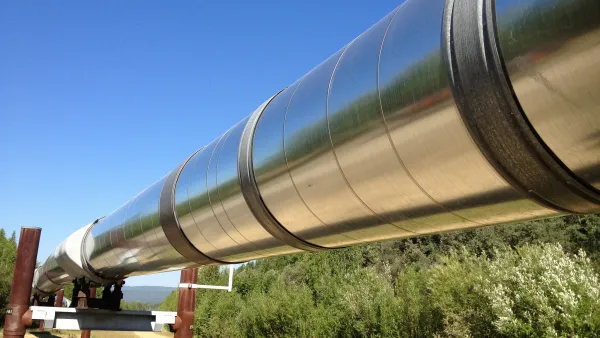
Plans for Massive Oil Pipeline to Philadelphia Taking Shape
Oil industry representatives have coalesced behind a plan to connect Philadelphia with the Marcellus Shale region with a large new pipeline. A recently completed conceptual plan for the pipeline is intended to build political support.
An 'Energy Hub' Boomtown—In Philadelphia?
The Marcellus Shale boom has inspired some in Philadelphia to imagine their city as the "next Houston"—if it can attract the businesses and infrastructure to bring oil and gas in for the benefit of a homegrown manufacturing economy.
Oil Trains from North Dakota to the Rescue in Philadelphia
The hazards of shipping North Dakotan crude-by-rail have been well documented and are the focus of new DOT regulations due to its volatility, but there's a more positive side to this oil and the trains that deliver it, illustrated in Philadelphia.

Planetizen Federal Action Tracker
A weekly monitor of how Trump’s orders and actions are impacting planners and planning in America.

California plans to bury El Niño’s downpour
If the state plays its cards right, it may be able to store a billion acre-feet of El Niño’s water in aquifers.

Chicago breaks ground on $3 billion megadevelopment
The new neighborhood, titled Foundry Park, will one day host 3,700 residences.

One of Denver’s busiest corridors to gain BRT
The project will span 18 miles and contain 74 bus rapid transit stations.

275,000 bus trips are at stake on Seattle's ballot
If passed, the Seattle Transit Measure would trigger a 0.3% sales tax and raise an average of $138 million per year to maintain and expand Seattle’s bus services.

Texas may pay Israeli company billions to ease water woes
Texas awarded IDE Technologies the contract for its Harbor Island project, which is slated to become the Western Hemisphere's largest desalination plant.

FREE Course: Walkable City 1: Why Walkability?
After describing his path towards focusing on walkability as the essence of good planning, Jeff Speck marches through his five principal reasons for making more walkable places.
Reinventing Malls: Planning Alchemy—Turning Gray Fields Into Gold
The course focuses on the opportunities and imperatives that shape reinvention of mall sites.

City of Rosemead
Rutgers University, Edward J. Bloustein School of Planning and Public Policy
One Hundred Miles
Hunter College, City University of New York (CUNY)
The Architects Foundation
University of Cincinnati Online
City of Cambridge
Montrose County
The Pocatello Development Authority