The commuter train had left Grand Central Terminal on Tuesday evening and hit the Jeep at a grade crossing in Valhalla, Westchester County at 6:30 pm. Five passengers died in the lead car of the train which was engulfed in flames from the impact.


Metro-North, operated by the New York State Metropolitan Transportation Authority (MTA), is an electrified commuter rail line that draws its electricity from what's referred to as a third rail, which became unhinged due to the force of the impact with the vehicle at the railroad crossing, now the deadliest crash in the the train line's history.
"Officials said the electrified third rail penetrated the vehicle and the train's first car, causing them to burst into flames," writes Kate Hinds of WNYC News. The driver of the Jeep also died.
A more precise account of what caused the fire was offered by Gov. Andrew Cuomo, reports the Daily News. "It appears that the [vehicle's] gasoline tank burst and that started the fire, consumed the [SUV] and consuming the first car of the first train,” Cuomo said on “CBS This Morning.”
The scene of the deadliest crash in Metro-North history was “as gruesome as I have seen,” the governor said. The entire first car, including all the seats, was burned or charred.
"No one here has ever seen anything like this," a law enforcement source told The Post. "It was a gruesome scene."
"It was not immediately clear why the car, described as a black Jeep Cherokee, was on the tracks," writes Hinds. "In an email, Metro-North spokeswoman Margie Anders said crossing gates came down on top of the vehicle."
The driver got out to look at the rear of the car," Anders wrote, "then she got back in and drove forward and was struck."
Gov. Cuomo told NY1 News, "Sometimes accidents just happen...Someone made a mistake and stopped on the tracks."
However, it's not even clear that the vehicle had stopped on the tracks when it was hit, according to accounts of the incident. After initially stopping, the motorist may have driven forwards thinking she could clear the tracks before the train passed.
"This is the second Metro-North crash with multiple fatalities in a little over a year," writes Hinds. "In December 2013, a train derailed in the Bronx, killing four and injuring scores." In May, 2013, two Metro-North trains collided near Fairfield, Conn., injuring 60 people, five of them critically.
The National Transportation Safety Board is investigating the crash scene in Valhalla. "The NTSB team will stay on the scene for five to seven days, but a full investigation will take about a year," reports the Daily News.
According to a Metro-North service alert, "Metro-North Harlem Line train service on Wednesday, February 4 will remain suspended between Pleasantville and North White Plains until further notice due to the train/car collision near Valhalla."
"Metro-North is the nation's second-busiest railroad, after the Long Island Rail Road," writes Hinds. "It was formed in 1983 and serves about 280,000 riders a day in New York and Connecticut."
Read the full story: 6 Killed in Metro-North Crash in Westchester

Examining Rail's Safety Record after Metro-North's Worst Crash
A column in The Week argues that notwithstanding Tuesday's horrific crash of a Metro-North train that killed five passengers, rail is a much safer mode than driving. However, rail deaths are increasing.
Done Deal: Manhattan Congestion Pricing
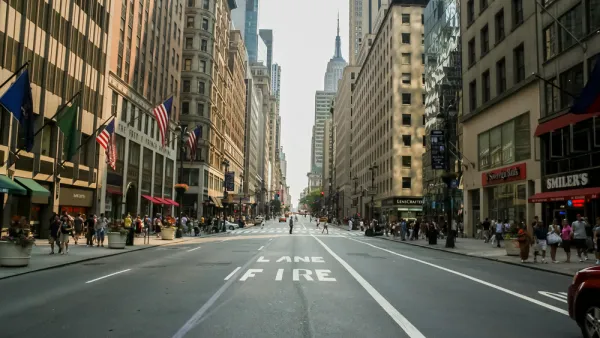
Finally, congestion pricing, as applied to city cordons, not highways, will be coming to the U.S., thanks to a budget deal approved by the New York State Legislature early Sunday morning. Tolls below 60th Street should begin by Jan. 1, 2021.
Railroads Given Three More Years to Install Positive Train Control
Agreement has been reached by Congress to extend the vital but costly safety system said to prevent many train crashes. Had it not been reached, freight railroads warned they would shut down, as would passenger rail lines running on their tracks.

Planetizen Federal Action Tracker
A weekly monitor of how Trump’s orders and actions are impacting planners and planning in America.

California plans to bury El Niño’s downpour
If the state plays its cards right, it may be able to store a billion acre-feet of El Niño’s water in aquifers.

Chicago breaks ground on $3 billion megadevelopment
The new neighborhood, titled Foundry Park, will one day host 3,700 residences.

California High-Speed Rail Authority CEO resigns after $600,000 scandal
Under Ian Choudri, the authority used taxpayer dollars to fund first class flights and trips to nightclubs.

Want to study the Missouri River? Soon, you may need unanimous approval from 10 states
Legislation would require 10 governors’ permission to study or build projects moving water outside the basin.

Desperate measures: Advocates weigh draining Lake Powell to fill Colorado River
Draining the reservoir could reduce evaporation losses by a couple hundred thousand acre-feet.

FREE Course: Walkable City 1: Why Walkability?
After describing his path towards focusing on walkability as the essence of good planning, Jeff Speck marches through his five principal reasons for making more walkable places.
Reinventing Malls: Planning Alchemy—Turning Gray Fields Into Gold
The course focuses on the opportunities and imperatives that shape reinvention of mall sites.

City of Rosemead
Rutgers University, Edward J. Bloustein School of Planning and Public Policy
One Hundred Miles
Hunter College, City University of New York (CUNY)
The Architects Foundation
University of Cincinnati Online
City of Cambridge
Montrose County
The Pocatello Development Authority