The atlantalarry blog shares news of a study in the Engineering Applications of Artificial Intelligence journal that used gelocalized tweets to map out nightlife areas in Madrid, London, and Manhattan.


As Larry Felton Johnson explains, the data in a recent study are "useful in urban planning, because it gives a good sense of what large groups of people are doing from hour to hour in a specific city or region." According to the the atlantalarry post, planners should be able to see the broader impacts of specific information. Although the study "mentions night life in particular, where the data might give guidance into allocation of resources for cleanup and noise mitigation."
The study, titled "Spectral clustering for sensing urban land use using Twitter activity," is by Enrique and Vanessa Frías-Martínez, brother and sister computer science researchers at Telefonica Research and the University of Maryland (USA), respectively.
The Science Daily post about the study includes this quote from Enrique Frías-Martínez explaining why the use of data crowd-sourced from Twitter might improve traditional forms of community engagement employed by planners: "you can capture information on urban land use more efficiently and for a much larger number of people than with questionnaires. Moreover, this type of consultation, traditionally used until now in planning activities, are very costly and can cause problems due to the lack of accuracy of the answers."
Read the full story: Analysis of tweets may be useful for urban planners

Researchers Pull Social Media Data to Track Migration
The limitations (and inaccuracies) of traditional data sources like the U.S. Census are well known, so researchers are looking social media to gather the data necessary to draw conclusions about societal movements.
Facebook's New Infographic: Where Are We 'Checking In'?
Tyler Falk reports on new data released by Facebook, mapping the top 5 "social landmarks" in 25 cities from Seoul to São Paulo.
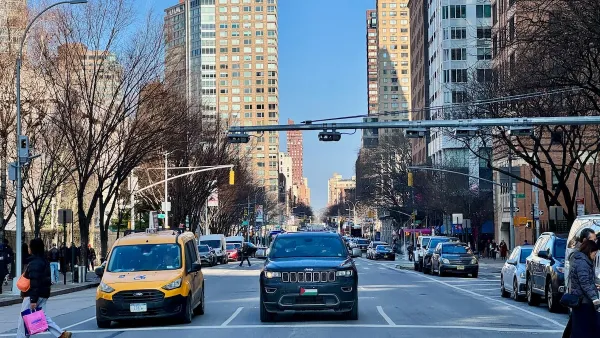
NYC’s ‘Rare and Comprehensive’ Public Data Reveals Congestion Pricing's Success
The Metropolitan Transportation Authority’s analytics and data team maintains over 180 regularly updated datasets about the city’s transportation system.

Planetizen Federal Action Tracker
A weekly monitor of how Trump’s orders and actions are impacting planners and planning in America.

California plans to bury El Niño’s downpour
If the state plays its cards right, it may be able to store a billion acre-feet of El Niño’s water in aquifers.

Desperate measures: Advocates weigh draining Lake Powell to fill Colorado River
Draining the reservoir could reduce evaporation losses by a couple hundred thousand acre-feet.

California city breaks ground on transit connector
The project includes three mobility hubs and a pedestrian bridge.

After public outcry, Massachusetts city releases housing development tracker
Cambridge’s tracker currently shows 250 housing projects in various stages of development.

40 years after approval, Chicago breaks ground on new park
The park honors Jean Baptiste Point du Sable, the city’s first permanent non-native settler.

FREE Course: Walkable City 1: Why Walkability?
After describing his path towards focusing on walkability as the essence of good planning, Jeff Speck marches through his five principal reasons for making more walkable places.
Reinventing Malls: Planning Alchemy—Turning Gray Fields Into Gold
The course focuses on the opportunities and imperatives that shape reinvention of mall sites.

City of Rosemead
Rutgers University, Edward J. Bloustein School of Planning and Public Policy
One Hundred Miles
Hunter College, City University of New York (CUNY)
The Architects Foundation
University of Cincinnati Online
City of Cambridge
Montrose County
The Pocatello Development Authority