When it comes to making sense of the American Community Survey's data on commute times, it's all about how you frame the data.


Writing for the Brookings Institution, Adie Tomer and Joseph Kane detail the recent commute data from the 2013 American Community Survey. While acknowledging that the "car is still king" for drivers in the United States, their analysis also finds a new trend emerging from the nation's largest metropolitan areas. "Over two-thirds of these places experienced driving declines between 2007 and 2013, while also simultaneously seeing a rise in commuters walking, bicycling or working at home," write Tomer and Kane.
Writing for the Population Reference Bureau, Beth Jarosz and Rachel T. Cortes find a different angle the 2013 ACS data, namely, that commutes are getting longer and more sedentary for Americans: "The average full-time worker in the United States spends almost 26 minutes commuting to work, according to just-released data from the 2013 American Community Survey," citing a series of infographics to back up the claim. Jarosz and Cortes then go on to point out the increase in active commute modes and even cites the exercise and stress benefits of biking to work.
Read the full story: Most Americans Still Driving, but New Census Data Reveal Shifts at the Metro Level
Millennials and Gen Xers Commuting Less by Car
Following up on earlier reports about the latest commuting data from the U.S. Census 2013 American Community Survey, Joseph Kane and Adie Tomer find different trends in commute choice between age groups.
Mapping the Morning Commute
What time did you leave for work this morning? What time should you have left for work this morning?
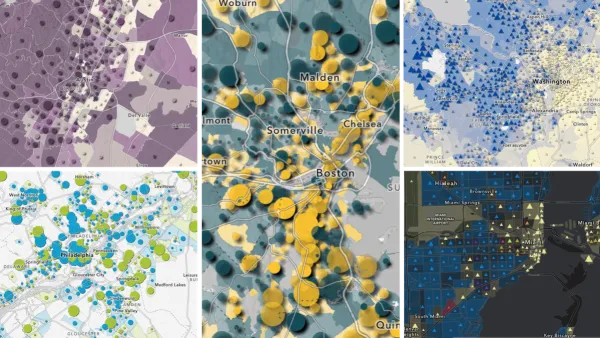
Explore US Demographics With the New ACS Atlas Collection
Esri's new ACS Atlas Collection offers interactive applications that visualize the latest U.S. demographic and socio-economic data, enabling users to explore over 175 curated web maps across various thematic areas.

Planetizen Federal Action Tracker
A weekly monitor of how Trump’s orders and actions are impacting planners and planning in America.

Eastern Nebraska is running out of electricity
Data centers and electrification are straining eastern Nebraska’s grid, throttling economic development.

Washington state to charge fee to drivers with fuel-efficient cars
Revenue from the fee will go towards supporting the state’s highways.

Instead of building new housing, LA developers are turning mansions into mega-mansions
In the richest areas, the number of houses valued at $30 million with demolition permits has skyrocketed since 2018.

Illinois considers spending $1 billion in taxpayer money on data center
A quantum computing campus and data center are currently under construction in Chicago.

As development costs rise, Boston moves to lessen affordable housing requirements
The Boston Zoning Commission and the City Council still need to approve Boston Mayor Michelle Wu’s proposed changes

FREE Course: Walkable City 1: Why Walkability?
After describing his path towards focusing on walkability as the essence of good planning, Jeff Speck marches through his five principal reasons for making more walkable places.
Reinventing Malls: Planning Alchemy—Turning Gray Fields Into Gold
The course focuses on the opportunities and imperatives that shape reinvention of mall sites.

City of Charlotte
City of Rosemead
Rutgers University, Edward J. Bloustein School of Planning and Public Policy
University of Michigan School for Environment and Sustainability (SEAS)
Hunter College, City University of New York (CUNY)
The Architects Foundation
University District Partnership
City of Cambridge
The Pocatello Development Authority