The Nebraska Supreme Court began hearing the case that will be considered before the Obama Administration will decide whether or not to authorize the controversial pipeline.


Last February we noted that Lancaster County District Court Judge Stephanie Stacy had dealt TransCanada, the builder of the controversial pipeline, a major setback. Jeff Brady, energy correspondent for NPR, brings us up to date after providing a brief background. [Listen here or download here.]
An early route through the environmentally sensitive Sand Hills region [where the Ogallala Aquifer is located] was widely criticized. But after the pipeline company TransCanada changed the route, Republican Governor Dave Heineman [initially an opponent] approved it. An attorney representing three land owners opposed to the pipeline also happens to be the Democratic nominee for U.S. Senator in Nebraska. Dave Domina will take a break from campaigning to argue before the state Supreme Court that the governor did not have the authority to approve the new route.
According to Domina,"(o)nly the Public Service Commission (created more than a century ago to curb the political influence of railroad barons) can handle the administrative process that goes with a specific route and its acceptance or rejection."
However, Senator Jim Smith authored a bill in 2012 that allowed the governor to make the routing decision. "(W)e would not have voted on it had we believed that it was unconstitutional," he states.
"It could take three months or more for the Nebraska Supreme Court to decide this case," writes Brady. "Depending on how justices rule, a final White House decision on the Keystone XL pipeline could be delayed until next year at the earliest," he adds, which will be just fine with President Obama who wants to delay his decision until after the November elections, as we noted last April.
Read the full story: Nebraska's Supreme Court To Hear Keystone XL Pipeline Case

Nebraska Supreme Court OKs Keystone XL; U.S. Senate has the Next Move
The House voted for the tenth time to approve the pipeline, and a split decision by the Nebraska Supreme Court removes a key objection of President Barack Obama to ruling on Keystone XL. The Senate begins debate Monday.
Keystone XL Dealt a Setback in Court—But Not from the Usual Suspects
The lawsuit comes from three private landowners who successfully sued to prevent their properties from being seized so that TransCanada can lay their pipeline—turns out the state Legislature was in too much of a rush in 2012 to approve the project.
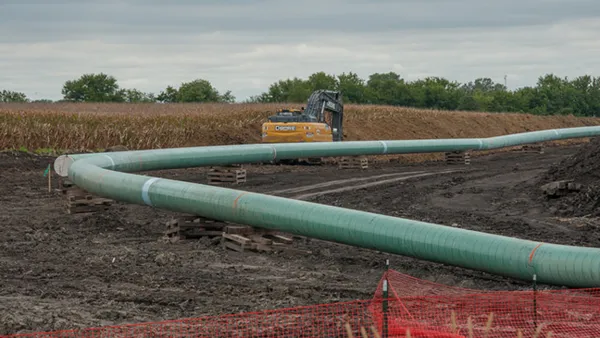
Nebraska Commission Authorizes Keystone XL Pipeline, But With a Major Twist
TransCanada got its second wish. Last March, President Trump reversed President Obama's rejection of the 1,136-mile pipeline to carry Alberta oil sands crude. On Monday, the Nebraska Public Service Commission OK'd a route, but not the one it wanted.

Planetizen Federal Action Tracker
A weekly monitor of how Trump’s orders and actions are impacting planners and planning in America.

The state-sanctioned urbicide of Austin
People don’t kill cities. Freeways do.

Colorado’s Largest Data Center Could Rise Next to Homes — Without a Public Hearing
The proposed campus would consume 11 times the power of Denver International Airport; as it has across the country, opposition mounts.

Nation's most wind-powered state turns to coal as data centers increase energy demand
For the first time in decades, Iowa has increased its generation of coal power.

NYC cools commuters with city's first rain garden above a bus stop
New York City officials say the plants in the rain garden can absorb 16 gallons of rainwater during heavy storms.

Brightline West’s future may rely on $6 billion federal loan
The company has until Nov. 2 to make a $400 million equity investment into its proposed high-speed rail line.

FREE Course: Walkable City 1: Why Walkability?
After describing his path towards focusing on walkability as the essence of good planning, Jeff Speck marches through his five principal reasons for making more walkable places.
Reinventing Malls: Planning Alchemy—Turning Gray Fields Into Gold
The course focuses on the opportunities and imperatives that shape reinvention of mall sites.

Greater Baltimore Committee
Eagle County Government
Harvard University Graduate School of Design
The Architects Foundation
University of Cincinnati Online
The Pocatello Development Authority
The Urban Renewal Agency of the City of Pocatello
Journal of the American Planning Association