With competition from California, Arizona, New Mexico, and Texas, Elon Musk, the CEO of Bay Area-based Tesla Motors, chose the Silver State to build his much sought after $5 billion battery "giga factory."


"State officials scheduled a news conference at 4 p.m. Thursday in Carson City to announce the plant," writes Mike Ramsey of The Wall Street Journal. "Tesla earlier this year began developing a site near Reno, Nev., though the company had said it was possible other states could still compete for the project," he adds.
Nevada likely offered Tesla one of the largest incentive packages in the history of the U.S. auto industry to lure the factory to a state with relatively little presence in automotive manufacturing."
The payoff will be enormous though for Nevada for securing the $5 billion battery factory. Tesla will "employ up to 6,500 workers and produce 35 gigawatt hours of battery cells annually in its so-called gigafactory," adds Ramsey.
In addition to the incentives, Nevada also offers Tesla "ready access to lithium, a key raw material for the batteries." However, one analyst stated that "the single most important factor is the [site's] low-cost green power,"
Reno offers Tesla choices among solar, wind and geothermal energy for the plant. He also said Nevada's lack of corporate and personal income taxes aided its selection.
"Karl Brauer, an industry analyst with Kelley Blue Book, says a carmaker making its own batteries is an even bigger deal for the auto industry because the battery pack is the most expensive part of producing an electric car and it's the one that car manufacturers previously - who've produced electric vehicles - have had the least control over," writes Sonari Glinton, NPR Business Desk reporter. "They've been basically at the mercy of battery makers."
Not all analysts are optimistic on Tesla's investment though. "(B)attery industry researchers and executives have been skeptical of Tesla's plan for the factory," writes Ramsey. "On Wednesday, Lux Research, issued a report estimating that the gigafactory would have 57% overcapacity in 2020 as sales of Tesla vehicles will be less than half of what the company is forecasting."
No word as to whether Musk held out for changing the state nickname from silver to lithium.
Correspondent's note: Subscriber-only content to Wall Street Journal article will be available to non-subscribers for up to seven days after Sept. 04.
FULL STORY: Tesla to Choose Nevada for Battery Factory

Nevada's $1.2 Billion Investment in Tesla Predicted to Have $100 Billion Impact
The generous incentives granted the electric car company for securing the $5 billion factory will yield disproportionate economic benefits, according to Gov. Brian Sandoval, for a state suffering high unemployment and a lack of economic diversity.
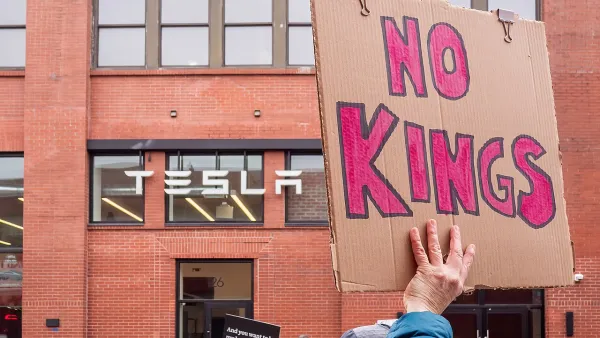
Dear Tesla Driver: “It’s not You, It’s Him.”
Amidst a booming bumper sticker industry, one writer offers solace to those asking, “Does this car make me look fascist?”

Tesla’s Self-Driving Still Not Working in Las Vegas Tunnels
The Boring Company had previously said it was working with Tesla to use its self-driving system in its tunnels below Las Vegas to save costs on drivers, but two years later, there is no clear timeline for “full autonomy.”

The state-sanctioned urbicide of Austin
People don’t kill cities. Freeways do.

US to reduce Colorado River water deliveries to Mexico
A new Colorado Treaty amendment reduces Mexico’s Colorado River water allocation by 250,000 acre feet.

New Jersey’s second-largest city bans standalone data centers
Jersey City will continue to allow co-location facilities, such as those meant for research institutions that store their own data.

Amtrak not solely to blame for New Jersey commuter rail's unreliability, report finds
A new study from the Garden State Initiative found that NJ Transit’s budget grew 20% across a 4 year period, but reliability declined significantly over the same period.

EPA erases limits on planet-warming pollution from power plants
Under Monday’s plan, power plants would still have some limits on how much mercury, arsenic and other contaminants they can emit.

Phoenix announces new on-demand transit service, more frequent RAPID buses
Both new services will launch in October, and are part of Phoenix's Project Effective Access Solutions for Easing Congestion.

FREE Course: Walkable City 1: Why Walkability?
After describing his path towards focusing on walkability as the essence of good planning, Jeff Speck marches through his five principal reasons for making more walkable places.
Reinventing Malls: Planning Alchemy—Turning Gray Fields Into Gold
The course focuses on the opportunities and imperatives that shape reinvention of mall sites.

Eagle County Government
Harvard University Graduate School of Design
Nashville Planning Department
The Architects Foundation
University of Cincinnati Online
The Pocatello Development Authority
The Urban Renewal Agency of the City of Pocatello
Journal of the American Planning Association