The Boring Company had previously said it was working with Tesla to use its self-driving system in its tunnels below Las Vegas to save costs on drivers, but two years later, there is no clear timeline for “full autonomy.”


It’s been a rough couple months for Elon-Musk-related ventures, with Tesla sales falling, X’s financial woes, Brazil banning the social media platform, and news that last year’s SpaceX rocket explosion punched a hole in Earth’s atmosphere. A recent article from Eletrek has called out another: “Tesla’s self-driving system is still not working in The Boring Company’s one-way tunnels under Las Vegas despite reportedly working on it for years,” writer Fred Lambert reports. Las Vegas Convention President and CEO Steve Hill told media that the goal is now to have “some driver assistance tool” used in the Loop by the end of the year, but there is no timeline for “full autonomy,” despite The Boring Company having said it was working with Telsa to use its self-driving system in the tunnels, touting it as a operation-cost reduction measure. So, in the words of a Gizmodo article back in 2021 when the project first opened, it is “still just humans driving cars slowly in a tunnel.”
The Las Vegas Convention Center Loop, which was completed in one year for around $50 million, is The Boring Company’s first full-scale loop project currently in commercial use, Lambert writes. The system consists of tunnels through which Tesla electric vehicles travel at high speeds between stations to transport people within a city. Currently those vehicles are driven by people between three stations at the convention center and one at the Resorts World hotel, with another at the Encore expected to open soon. “Overall, 93 stations and 68 miles of tunnels are planned as part of the Loop under Las Vegas.”
Given the delay in getting Tesla’s self-driving systems working in such a closed, predictable, fixed-route environment, the article expresses some skepticism at industry claims that self-driving in Tesla vehicles on public roads is just around the corner. It concludes with a bit of commentary from Lambert: “I like The Boring Company. Tunnels are a smart solution for increasing transport capacity in urban areas, and if the startup can reduce the cost of tunneling, it’s a net positive overall. However, the way they use the tunnels right now, with drivers transporting a few passengers in Tesla vehicles in those one-way tunnels, doesn’t seem to be the best use. I think as of now, a subway system would be more useful.”
Related Planetizen commentary: Opinion: Stop Trusting Elon Musk—on Tunnels, on Teslas, on Everything
FULL STORY: Tesla’s self-driving is still not working in Boring Company’s one-way tunnels


Las Vegas Doubles Down on Elon Musk and the Boring Co.
The Clark County Commission wants more Teslas in more tunnels.
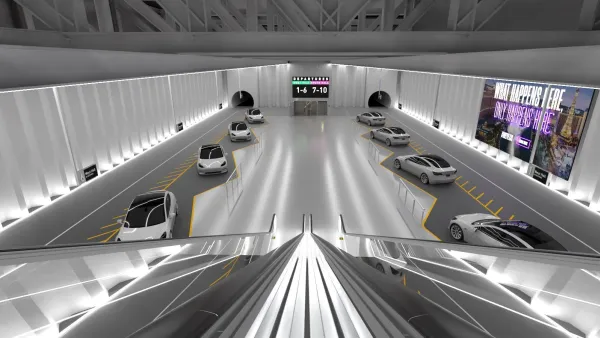
Teslas Driving Slowly in a Brightly Lit Tunnel: The Boring Co.'s Las Vegas Debut
The first big operations test for the Las Vegas Convention Center Loop is coming during a conference planned for June, but the lights have been turned on and cameras are rolling.
The Boring Company Coming Up Short of Expectations in Las Vegas
It seems like the Las Vegas Convention and Visitor’s Authority expected trouble with The Boring Company, and built a contract that will impact Elon Musk's bottom line for falling short of agreed system capacity and construction timelines.

Planetizen Federal Action Tracker
A weekly monitor of how Trump’s orders and actions are impacting planners and planning in America.

The state-sanctioned urbicide of Austin
People don’t kill cities. Freeways do.

US to reduce Colorado River water deliveries to Mexico
A new Colorado Treaty amendment reduces Mexico’s Colorado River water allocation by 250,000 acre feet.

5 New England states march closer to 800 megawatt wind energy project
Securing federal approval for the project may be complicated under the Trump administration, which has historically been hostile towards domestic wind power.

Baltimore to break ground on $50 million Transit Priority Project
The project will bring faster bus trips, safer streets and better bike connections to Baltimore.

Airbnb launches $250 million 'last-dollar financing' housing accelerator, makes first investment in Austin
The company will put $6.4 million towards affordable housing development in Texas’ capital.

FREE Course: Walkable City 1: Why Walkability?
After describing his path towards focusing on walkability as the essence of good planning, Jeff Speck marches through his five principal reasons for making more walkable places.
Reinventing Malls: Planning Alchemy—Turning Gray Fields Into Gold
The course focuses on the opportunities and imperatives that shape reinvention of mall sites.

.jpg)
Eagle County Government
Harvard University Graduate School of Design
Nashville Planning Department
The Architects Foundation
University of Cincinnati Online
The Pocatello Development Authority
The Urban Renewal Agency of the City of Pocatello
Journal of the American Planning Association