That was the message from Gov. Jerry Brown after a state appeals court unlocked a lower court's hold on $9.95 billion of state bond funds for the $68 billion project. He exchanged words with HSR opponent House Majority Leader Kevin McCarthy.


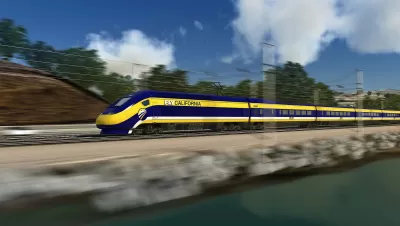
While Gov. Jerry Brown was no doubt greatly relieved by the July 31st state appeals court ruling, we are reminded by Alejandro Lazo of The Wall Street Journal of the difficult funding road ahead for the California high speed rail (HSR) project, ironically in part due to the powerful congressman whose Bakersfield district the high speed train will serve.
"Majority Leader Kevin McCarthy (R-Calif.) has vowed to block any additional federal money for the project," writes Lazo. In fact, McCarthy co-sponsored legislation by fellow Central Valley Republican Congressman Jeff Denham in January to suspend federal funding for the California High Speed Rail project.
It's well within the capability of the state of California [to build the project without federal help]," Mr. Brown said in an interview last week with The Wall Street Journal. "We would like more federal help. We get federal help for our roads and our bridges…but right now the Republicans, under Mr. McCarthy, have decided that it's better to treat high-speed rail as a political football, than as a great civic opportunity."
"The majority leader said in a statement Sunday that the program originally sold to California voters in 2008 is 'a far cry' from the current one the governor is pushing, and he would continue to fight the program in Congress," writes Lazo.
"I will do all that I can to ensure not one dollar of federal funding goes to boondoggles like California's high-speed rail," Mr. McCarthy said. "The government's handling of hard earned taxpayer dollars must be based on merit and facts, not upon a desired legacy."
While it is generally acknowledged that Brown does view high speed rail to be a legacy project, particularly by project opponents, McCarthy must know that funds awarded to the California project, or any rail or transit project for that matter, must undergo scrutiny by the Federal Railroad Administration or Federal Transit Administration "based on merit and facts".
Speaking of the FRA and McCarthy's district, on June 27 the FRA "issued a Record of Decision (ROD) for the 114-mile Fresno to Bakersfield Section [see CHSRA map (PDF)] of the California High-Speed Train System," according to an FRA press release. "The ROD is the last step in the National Environmental Policy Act process and clears the way to break ground on the project," it continues.
Meanwhile, Tim Sheehan of The Fresno Bee writes that demolition began last month in Fresno to clear way for the project on the first construction section, Merced to Fresno [see map (PDF)]. Sheehan earlier wrote that construction could start soon in Madera.
Correspondent's Note: Subscriber-only content of The Wall Street Journal article will be available to non-subscribers for up to seven days after August 4.
Read the full story: California Plans Bullet Train Without More U.S. Aid
CEQA and High-Speed Rail Foes Dealt Setback by Federal Board
Faced with seven CEQA lawsuits from rail opponents threatening to delay the high-speed rail project, the California High-Speed Rail Authority sought preemption of the California environmental law. The Surface Transportation Board agreed.
CA High Speed Rail Receives More Good News from Feds
Two days after the CA High Speed Rail Authority received federal environmental streamlining of the 60-mile Merced to Fresno segment, the Federal Railroad Administration announced they will do the same for the 114-mile Fresno to Bakersfield segment.
California Gas Tax Repeal Initiative Qualifies for November Ballot
The initiative is much more than whether to repeal taxes and fees enacted by the passage of the Road Repair and Accountability Act of 2017 which brings in over $5 billion a year. The measure is a means to increase GOP turnout to retain House seats.

Planetizen Federal Action Tracker
A weekly monitor of how Trump’s orders and actions are impacting planners and planning in America.

Washington state to charge fee to drivers with fuel-efficient cars
Revenue from the fee will go towards supporting the state’s highways.

Study reveals best places in the U.S. for cycling, walking
New research from Streetlight Data examines bicycle and pedestrian miles per capita in the 100 largest U.S. cities by population.

Mamdani unveils his ‘most ambitious bus lane project’ so far
The city has added two new bus lanes, which it expects to speed up tens of thousands of bus riders’ commutes.

New Jersey and New York suggest $10.3 billion budget for transit
Some of the budget is dedicated to replacing Manhattan's Midtown Bus Terminal.

States split over EPA’s proposal to drop greenhouse gas rules for power plants
The proposed rule drew over 165K comments, including from officials, health and environmental groups, and private citizens.

FREE Course: Walkable City 1: Why Walkability?
After describing his path towards focusing on walkability as the essence of good planning, Jeff Speck marches through his five principal reasons for making more walkable places.
Reinventing Malls: Planning Alchemy—Turning Gray Fields Into Gold
The course focuses on the opportunities and imperatives that shape reinvention of mall sites.


City of Charlotte
City of Rosemead
Rutgers University, Edward J. Bloustein School of Planning and Public Policy
University of Michigan School for Environment and Sustainability (SEAS)
Hunter College, City University of New York (CUNY)
The Architects Foundation
University District Partnership
City of Cambridge
The Pocatello Development Authority