Robert Bruegmann, professor emeritus of art history, architecture, and urban planning at the University of Illinois at Chicago, defends the recent attacks against Atlanta, especially regarding its sprawling footprint.


"The most recent confirmation of Atlanta’s status as an icon of American sprawl," according to Robert Bruegmann, "comes in a new report from Smart Growth America called 'Measuring Sprawl 2014.'" The report found Atlanta to be the country's most sprawling metro, compared with New York City's least sprawling metro.
Bruegmann, however, rejects many of the study's findings, and insists that Atlanta's doubters have it wrong.
"You would think from the commentary that Atlanta is flat on its back. In fact, of course, Atlanta, over the last half century, has obviously seen its population and its economy grow faster than most of the older, higher-density, more transit-oriented cities of the United States or Europe. It must be doing something right, perhaps including the way it has sprawled."
Bruegmann claims that traffic congestion is usually worse in dense urban areas, before providing possible explanations for why Atlanta performs worse in congestion than he expects from a less-dense area. Here's a sample: "Infrastructure almost always lags in places that experience extremely fast population and economic growth. In other words, traffic congestion is, in part, an almost inevitable by-product of Atlanta’s undeniable and enviable economic success."
Bruegmann also prescribes some do's and don't's for the cities ongoing approach to the problem of congestion.
Read the full story: Sprawl Is Good for You

Suburban Poverty Rising in Atlanta
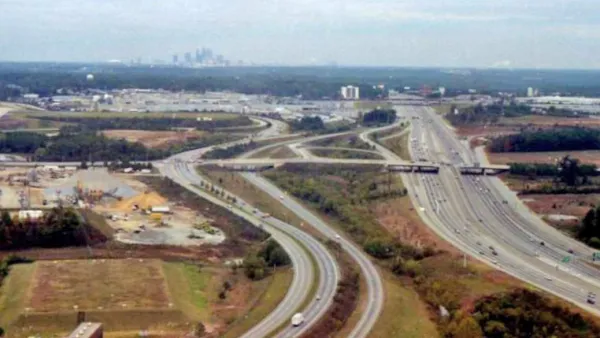
Driven by economic and demographic trends, poverty in "outer ring" suburbs is on the rise. Since 2000, Atlanta's suburbs have seen the highest rate of change in poverty of any comparable metro region.
A Detailed History of Atlanta's 'War on Density'
The Atlanta Studies website takes a deep dive into the history that produced the city of Atlanta as we know it today—and provides some suggestions on how to "correct some of its most atrocious attacks on the urban built environment."
Atlanta Beltline Symbolizes Efforts to Reverse Tide of Sprawl
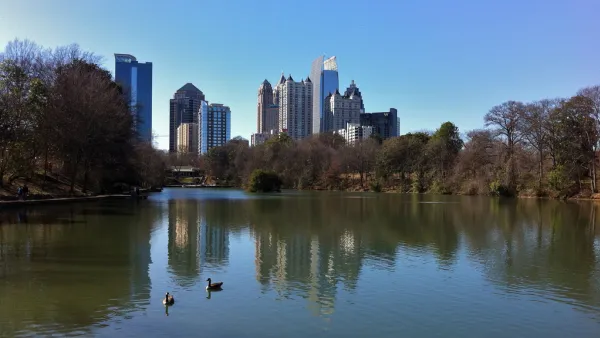
Famously far-flung Atlanta is finding a comforting psychic barrier in the BeltLine, a 45-mile greenbelt in the place of former railroad tracks. The city and developers are trying to make the urban core more functional and attractive.

Planetizen Federal Action Tracker
A weekly monitor of how Trump’s orders and actions are impacting planners and planning in America.

Amtrak, CN end decades-long dispute with eight-year agreement
The new operating agreement establishes an updated framework for the companies to work together, including processes to resolve disputes.

Judges permit Denver to divert 77,000 acre feet from the Colorado River for reservoir expansion
Overuse and climate change have caused the Colorado River’s water levels to plummet.

NYC DOT wants faster, more permanent street upgrades
The city is examining ways to build more concrete infrastructure without getting entangled in 'decades-long' projects.

'Something we’ve never seen before:' rising utility rates could strain city finances nationwide
Data centers, climate change and other factors have caused utility rates in the United States to increase by 38% since 2020.

Trump to overrule local leaders, lease millions of acres of America’s Pacific Island territories’ seafloors to mining companies
International law says that the Indigenous people of America’s territories have a right to prior and informed consent regarding projects that impact their countries.

FREE Course: Walkable City 1: Why Walkability?
After describing his path towards focusing on walkability as the essence of good planning, Jeff Speck marches through his five principal reasons for making more walkable places.
Reinventing Malls: Planning Alchemy—Turning Gray Fields Into Gold
The course focuses on the opportunities and imperatives that shape reinvention of mall sites.

Harvard University Graduate School of Design
KFH Group Inc.
Greater Baltimore Committee
The Architects Foundation
University of Cincinnati Online
The Pocatello Development Authority
The Urban Renewal Agency of the City of Pocatello