We've come to expect hight air pollution levels in Beijing and other Asian cities with high traffic levels and surrounded by dirty coal plants, but not in cities using emission-free nuclear energy and lots of bikes and mass transit. So why Paris?


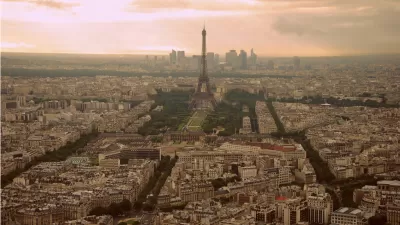
The Eiffel Tower was shrouded in smog on Friday (March 14), not what one would expect in Paris. The pollution "has been building for days as a high-pressure system over the region created a string of sunny days with little wind, cold nights and warm days that left pollutants trapped in this low-lying city on the Seine River. Until this week, there had been little concerted effort to reduce pollution from cars and trucks," writes Alissa J. Rubin.
But now that it's here, perhaps no other city can match the mitigations undertaken to reduce pollution levels.
"Paris has been on the forefront of bicycle- and car-sharing, putting ranks of bikes and small electric cars in most neighborhoods and allowing Parisians and tourists to pay low rates to rent them," writes Rubin. And with the pollution, Parisians and visitors will enjoy free public transit for the next three days.
In a New York Times article posted here last October on European air pollution, Paris was rated #250 in the graphic of selected cities.
However, it turns out that France may deserve some blame as the high concentration of pollutants may not be entirely due to the extremely mild winter:
The European Commission has repeatedly warned France that it is not complying with Europe-wide rules on air contaminant levels.
The pollution is not restricted to the Paris region nor even France. "Current concentrations of particulate matter (PM10) are unusually high across a wide region of Western Europe," reports the European Environment Agency. They add, "While the current levels in Europe pose a significant risk to health, peak levels can be up to 4-5 times higher in Asian cities like Beijing."
And while Paris can boast having among the world's best public transit systems and France has among the cleanest utilities, it could learn a thing or two from polluted California regions. While the government "asked people to refrain from burning wood in their fireplaces," regulators in the Bay Area, Central Valley, and Los Angeles have already implemented mandatory "no burn" days, backed-up with citations.
Update, March 16: Paris bans driving on alternate days because particulate pollution exceeded permissible levels for the last five days, reports The Telegraph.
From 5.30am on Monday, only cars with odd-numbered licence plates will be allowed to drive in the Île-de-France region, with the restrictions applying to even-numbered cars on Tuesday if, as predicted, the air pollution continues.
Read the full story: High Levels of Pollution Spur Paris to Action

Choking Air Pollution in Paris Prompts Driving Restrictions and Free Transit
A weather inversion has caused the highest air pollution in the French capital in ten years. To coax commuters from their cars, free transit and odd-even license plate driving restrictions were enacted by Mayor Anne Hidalgo on Tuesday
France Rethinks Its Diesel Fuel Addiction
Unlike the U.S., most passenger vehicles in Europe run on diesel fuel, not gasoline, and from a public health perspective, diesel emissions can severely exacerbate particle pollution during weather inversions like the one Paris is now experiencing.

The Surprising Region with the Nation's Worst Particulate Air Pollution
It's not Southern California, with its ports and congested freeways, California's Central Valley, with its bowl-like topography, Houston, with its oil refineries, or the midwest, with its coal power plants. Hint: think Santa Claus.

Planetizen Federal Action Tracker
A weekly monitor of how Trump’s orders and actions are impacting planners and planning in America.

Amtrak, CN end decades-long dispute with eight-year agreement
The new operating agreement establishes an updated framework for the companies to work together, including processes to resolve disputes.

Judges permit Denver to divert 77,000 acre feet from the Colorado River for reservoir expansion
Overuse and climate change have caused the Colorado River’s water levels to plummet.

Atlanta City Council unanimously backs $3.5 billion Beltline light rail project
The resolution was drafted after Atlanta Mayor Andre Dickens pulled support for the Atlanta Streetcar extension last year.

SEPTA to bring nearby frequent transit to over 1 million new riders as part of decade-long plan
The agency's Accelerate plan will also bring frequent transit to twice the amount of jobs that are currently located near it.

NYC plants over 18,000 trees, the most new foliage in a decade
Many of the trees were planted in communities vulnerable to extreme heat.

FREE Course: Walkable City 1: Why Walkability?
After describing his path towards focusing on walkability as the essence of good planning, Jeff Speck marches through his five principal reasons for making more walkable places.
Reinventing Malls: Planning Alchemy—Turning Gray Fields Into Gold
The course focuses on the opportunities and imperatives that shape reinvention of mall sites.

City of Thousand Oaks
City of Wisconsin Rapids
Harvard University Graduate School of Design
The Architects Foundation
University of Cincinnati Online
The Pocatello Development Authority
The Urban Renewal Agency of the City of Pocatello