Unlike the U.S., most passenger vehicles in Europe run on diesel fuel, not gasoline, and from a public health perspective, diesel emissions can severely exacerbate particle pollution during weather inversions like the one Paris is now experiencing.


As Paris enters the first day (Monday) of its partial motoring ban with driving restricted to vehicles with odd-numbered licence plates, The Atlantic Cities European correspondent, Feargus O'Sullivan writes that the unhealthy particulate pollution levels are causing some in Paris to rethinking their "love of diesel fuel". Already Paris excluded electric and hybrid vehicles from its driving ban. If pollution levels persist Tuesday, only vehicles with even-numbered license plates will be permitted to drive. Others risk a €22 fine.
What France really needs to do, according to a number of environmentalists, is slash its dependency on diesel-powered engines. An estimated 60 percent of French vehicles currently run on diesel. This higher than average level dates from the 1960s, when French governments promoted diesel in the mistaken belief that it was cleaner than gasoline. In fact, diesel has both higher carbon emissions and carcinogenic fine particles, the form of invisible pollution from which France is currently suffering a major spike.
O'Sullivan adds that there has been no program to wean Paris' dependency on diesel. This year, "Paris introduced 320 new diesel-powered public buses." In California cities with high pollution levels such as Sacramento [PDF] and Los Angeles, the bus fleets have been converted to run on much cleaner compressed natural gas. See EPA's "California Laws and Incentives for Natural Gas."
No politician now wants to be associated with Paris's new diesel buses and Anne Hidalgo, current mayoral frontrunner, has vowed to eliminate diesel entirely from the area of Paris under her jurisdiction. This crisis could well be the beginning of the end of France's love affair with diesel.
Early reports show that the partial driving ban has contributed to reducing traffic congestion by 60%. "This should help to ease, if not eradicate, high levels of toxic particulates entering the atmosphere, where warm air above is trapping them close to the ground," writes O'Sullivan.
Correction to Monday's "High Pollutions Levels in an Unexpected City". While the New York Times captioned the image of the Eiffel Tower, "A view...seen through thick smog on Friday," The Atlantic Cities refers to the type of pollution that cloaked the iconic structure as "a small-particle haze". Smog and particle or particulate pollution [PDF] are different types of air pollution. See the Air Quality Index [PDF] used by EPA to determine public health levels that correspond to particle pollution levels.
Read the full story: Air Quality Woes May Finally Force Paris to Rethink Its Love of Diesel Fuel

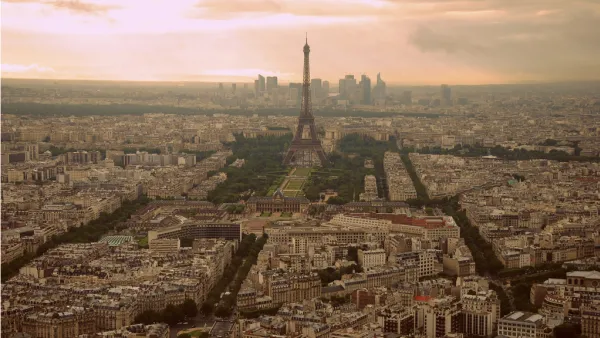
High Pollutions Levels in an Unexpected City
We've come to expect hight air pollution levels in Beijing and other Asian cities with high traffic levels and surrounded by dirty coal plants, but not in cities using emission-free nuclear energy and lots of bikes and mass transit. So why Paris?
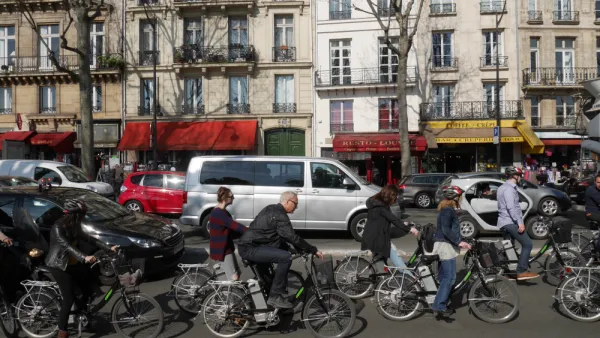
Bikes Take Priority in Post-Lockdown Paris
Faced with the task of rethinking its transportation systems in the face of the ongoing public health crisis, Paris and the Île-de-France are clearing the way for people on bikes.
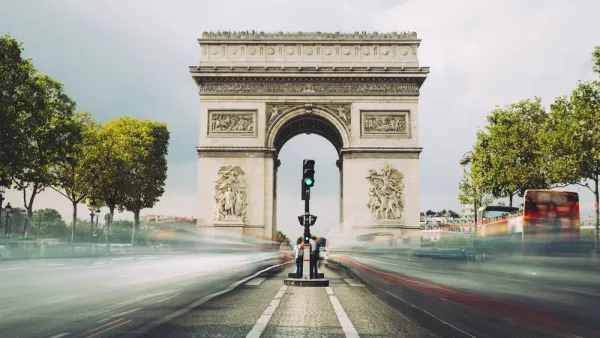
Less and Less of Paris Open to Cars
Paris Mayor Anne Hildalgo announced a new plan to further restrict cars and trucks from the city center.

Planetizen Federal Action Tracker
A weekly monitor of how Trump’s orders and actions are impacting planners and planning in America.

Amtrak, CN end decades-long dispute with eight-year agreement
The new operating agreement establishes an updated framework for the companies to work together, including processes to resolve disputes.

Judges permit Denver to divert 77,000 acre feet from the Colorado River for reservoir expansion
Overuse and climate change have caused the Colorado River’s water levels to plummet.

Atlanta City Council unanimously backs $3.5 billion Beltline light rail project
The resolution was drafted after Atlanta Mayor Andre Dickens pulled support for the Atlanta Streetcar extension last year.

SEPTA to bring nearby frequent transit to over 1 million new riders as part of decade-long plan
The agency's Accelerate plan will also bring frequent transit to twice the amount of jobs that are currently located near it.

NYC plants over 18,000 trees, the most new foliage in a decade
Many of the trees were planted in communities vulnerable to extreme heat.

FREE Course: Walkable City 1: Why Walkability?
After describing his path towards focusing on walkability as the essence of good planning, Jeff Speck marches through his five principal reasons for making more walkable places.
Reinventing Malls: Planning Alchemy—Turning Gray Fields Into Gold
The course focuses on the opportunities and imperatives that shape reinvention of mall sites.

City of Thousand Oaks
City of Wisconsin Rapids
Harvard University Graduate School of Design
The Architects Foundation
University of Cincinnati Online
The Pocatello Development Authority
The Urban Renewal Agency of the City of Pocatello