A weather inversion has caused the highest air pollution in the French capital in ten years. To coax commuters from their cars, free transit and odd-even license plate driving restrictions were enacted by Mayor Anne Hidalgo on Tuesday


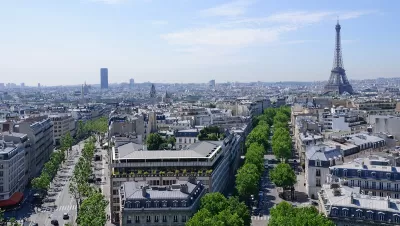
"Paris pollution consists of fine particles mostly from residential heating and cars," reports Elaine Beardsley, a Paris-based correspondent for National Public Radio. The pollution is "compounded by a weather phenomenon known as inversion where warmer, heavier air keeps colder air and pollution trapped on the ground."
The free transit comes with major costs, "around €4 million a day," about $4.2 million, reports Oliver Gee for The Local, to be "footed by the region's transport authority STIF." It will continue for a fourth day, Friday, according to STIF.
An expert warns that the fine particulate pollution, which is emitted in higher concentrations from diesel vehicles than gasoline-powered cars, is so serious that breathing the ambient air for an hour can impact one's health. And that warrants extreme measures.
The inversion comes days after Paris, Athens, Mexico City, and Madrid agreed to ban diesel vehicles from their city centers.
As for the effectiveness of the driving restrictions, Gee writes that thousands of drivers ignore them On the first day, Dec. 6, "1,700 were fined for flouting the ban."
However, changes are in store for drivers and their vehicles to replace the odd-even restrictions.
Paris will roll out new anti-pollution sticker system next year. During spikes in air pollution the most polluting vehicles will be banned instead of barring cars based on their number plates.
Readers may recall that Mayor Hidalgo enacted similar restrictions due to unhealthy air quality in 2014 and 2015. In July, Paris banned vehicles older than 19 years from driving in the city on workdays. Apparently more measures are needed to protect Parisians' health.
Since wood burning was indicated as a source of air pollution, Paris could learn from regions in California that have enacted wood-burning restrictions. For example, in the Bay Area, "when a Winter Spare the Air Alert has been called, burning wood, firelogs, pellets, or any other solid fuels in your fireplace, woodstove, or other wood-burning device is illegal," warns the Bay Area Air Quality Management District (BAAQMD).
FULL STORY: Air Pollution Leads To Crackdown On Cars In Paris

Smog So Bad United Airlines Won't Fly There
It's not the poor visibility but the air quality, ten times worse than Beijing, that has caused the airline to stop flying to New Delhi.
Paris to Begin Serious Car Restrictions on July 1
The carefree days of driving any-old-junker-they-please are over for Parisians, and they'll be even further obsolete when the calendar changes from June to July.
Saying Bye-Bye to Fireplaces And Wood-Burning Heaters in the Bay Area
In a Bay Area first, new home construction in most of the region will be banned from having these heating devices installed as the result of a rule adopted unanimously by the Bay Area Air Quality Management District on Oct. 21.

The state-sanctioned urbicide of Austin
People don’t kill cities. Freeways do.

US to reduce Colorado River water deliveries to Mexico
A new Colorado Treaty amendment reduces Mexico’s Colorado River water allocation by 250,000 acre feet.

New Jersey’s second-largest city bans standalone data centers
Jersey City will continue to allow co-location facilities, such as those meant for research institutions that store their own data.

Amtrak not solely to blame for New Jersey commuter rail's unreliability, report finds
A new study from the Garden State Initiative found that NJ Transit’s budget grew 20% across a 4 year period, but reliability declined significantly over the same period.

EPA erases limits on planet-warming pollution from power plants
Under Monday’s plan, power plants would still have some limits on how much mercury, arsenic and other contaminants they can emit.

Phoenix announces new on-demand transit service, more frequent RAPID buses
Both new services will launch in October, and are part of Phoenix's Project Effective Access Solutions for Easing Congestion.

FREE Course: Walkable City 1: Why Walkability?
After describing his path towards focusing on walkability as the essence of good planning, Jeff Speck marches through his five principal reasons for making more walkable places.
Reinventing Malls: Planning Alchemy—Turning Gray Fields Into Gold
The course focuses on the opportunities and imperatives that shape reinvention of mall sites.

Eagle County Government
Harvard University Graduate School of Design
Nashville Planning Department
The Architects Foundation
University of Cincinnati Online
The Pocatello Development Authority
The Urban Renewal Agency of the City of Pocatello
Journal of the American Planning Association