There are few hot buttons in planning conversation like the word “density.” One writer in San Diego claims that the breakdown inspired by the term originates from concerns with cars, not buildings.


Walter Chambers examines the ongoing contentiousness in the city of San Diego surrounding the word density. Chambers points out that density can lend itself to technical and impersonal considerations, rather than focusing not he quality of life benefits that are possible when people live and interact in proximity to each other.
“But when the conversation turns to density, we talk about objects — number of apartments, big buildings, etc. To make matters worse, community planners talk about density as ‘dwelling units per acre’ (du/acre), which doesn’t exactly speak to people and experiences.”
Intead, Chambers recommends that planners should talk “in terms of how people make a great city. Let’s understand density as increasing the opportunities for social exchanges between people, or ‘social exchanges per acre’ (sx/acre). Let’s talk about people and experiences.”
The real issue, however, is that “When you look at city planning from [an] auto-centric point of view, which most of us have been taught to do, higher density doesn’t make a lot of sense.”
Read the full story: Density Isn’t a Dirty Word
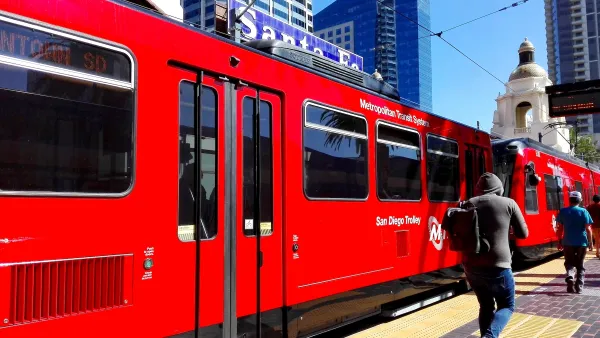
San Diego wants to limit upzoning law to just 16% of transit-adjacent parcels
The city's planning director says some areas are unfit for immediate upzoning due to a lack of resources or hazards such as wildfire risk.
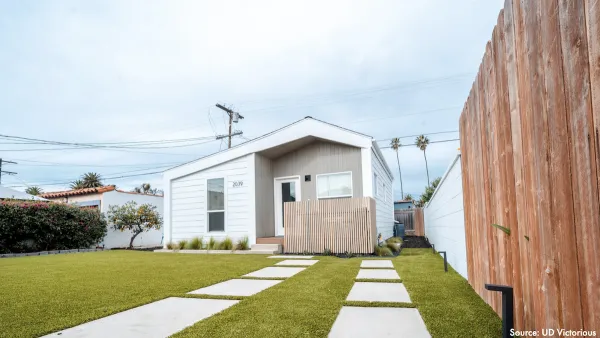
San Diego County ADUs Account for Over 30% of New Housing Permits
A now-expired incentive helped boost ADU applications since 2021 while larger housing projects have stalled.
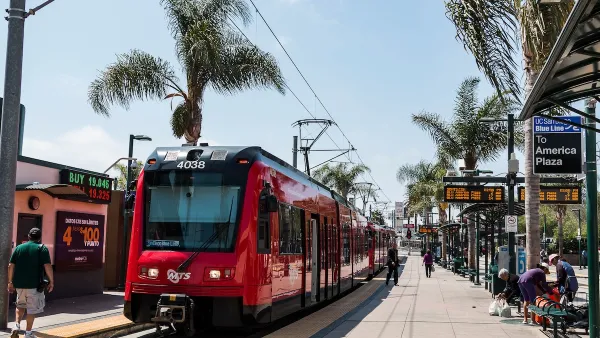
1,000 New Homes Sprouting Around San Diego Trolley Station
Multiple projects, helped along by city and state incentives, will densify the area around the Palm Avenue station.

Planetizen Federal Action Tracker
A weekly monitor of how Trump’s orders and actions are impacting planners and planning in America.

Washington state to charge fee to drivers with fuel-efficient cars
Revenue from the fee will go towards supporting the state’s highways.

Illinois considers spending $1 billion in taxpayer money on data center
A quantum computing campus and data center are currently under construction in Chicago.

Senate passes bill overhauling permitting
The bill still needs to pass the House.

Did data centers change how voters cast their ballots?
Texas, Ohio, and Georgia all flipped party control. But in rural counties, the effect of local data centers was mixed.

Amtrak invests in eight new Airo trainsets
The new trainsets will begin serving passengers in 2031.

FREE Course: Walkable City 1: Why Walkability?
After describing his path towards focusing on walkability as the essence of good planning, Jeff Speck marches through his five principal reasons for making more walkable places.
Reinventing Malls: Planning Alchemy—Turning Gray Fields Into Gold
The course focuses on the opportunities and imperatives that shape reinvention of mall sites.

City of Charlotte
City of Rosemead
Rutgers University, Edward J. Bloustein School of Planning and Public Policy
University of Michigan School for Environment and Sustainability (SEAS)
Hunter College, City University of New York (CUNY)
The Architects Foundation
University District Partnership