As cities across the Unites States look to lure immigrants to grow their populations and economies, many are turning to a program in New York for advice. Kirk Semple looks at the city's pioneering Office of Immigrant Affairs.


"In the past few years, New York’s Office of Immigrant Affairs has become a prime resource — even a model — for cities around the world seeking to better accommodate and serve their increasingly diverse populations," writes Semple. "[Commissioner Fatima Shama] and her staff have provided direct assistance to more than 20 cities in the United States and abroad — including Baltimore, Boston, Chicago and Los Angeles as well as Florence and Turin in Italy — and at least 10 eventually set up their own immigrant affairs offices."
"The office’s mandate is to serve as a bridge — 'the connective tissue,' Ms. Shama called it — between the immigrant population and city government, providing policy analysis and recommendations to the mayor as well as improving immigrants’ access to city services."
Read the full story: New York City’s Office for Immigrants Has Become a Global Model
New York Suspends Land Use Reviews for Shelters
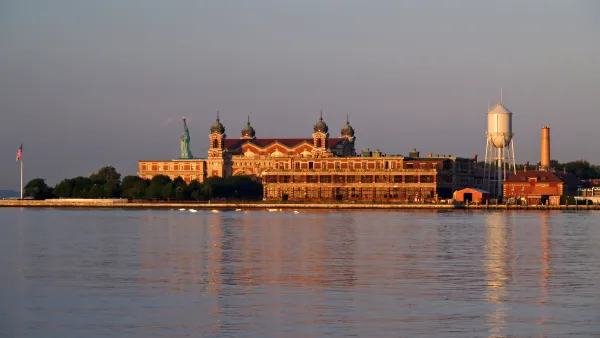
The Adams administration in New York City will relax the review process for homeless shelters to create new space for arriving asylum seekers.
Popular transit payment system linked to Palantir could give ICE access to rider data
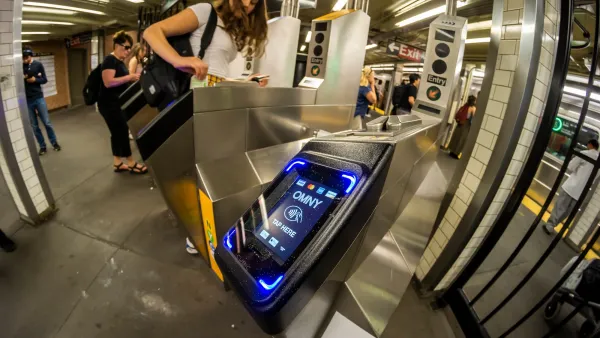
The tap-to-pay system is being used widely in transit systems including New York City, Boston and Chicago.
DOT withholds $73M from New York over immigrant trucking licenses
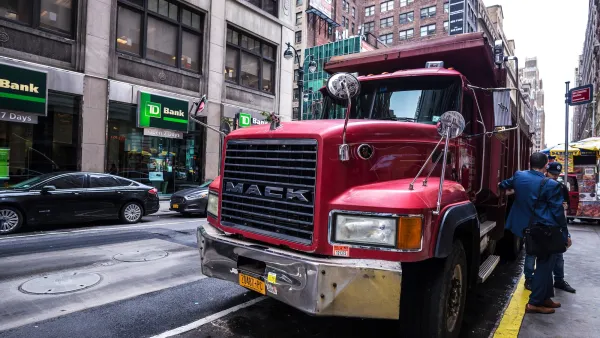
The Trump administration is requiring states to revoke the CDLs of non-domiciled drivers without proof of citizenship or risk losing federal funds.

Planetizen Federal Action Tracker
A weekly monitor of how Trump’s orders and actions are impacting planners and planning in America.

California plans to bury El Niño’s downpour
If the state plays its cards right, it may be able to store a billion acre-feet of El Niño’s water in aquifers.

Desperate measures: Advocates weigh draining Lake Powell to fill Colorado River
Draining the reservoir could reduce evaporation losses by a couple hundred thousand acre-feet.

Los Angeles just elected an urban planner as its mayor
Transportation analysts are optimistic that Raman will be more aggressive in addressing transit issues than Bass.

Mamdani’s pied-à-terre tax survives legal challenge
A panel of judges found that the plaintiffs failed to demonstrate injury as a result of New York City's implementation of the tax.

Eastern Nebraska is running out of electricity
Data centers and electrification are straining eastern Nebraska’s grid, throttling economic development.

FREE Course: Walkable City 1: Why Walkability?
After describing his path towards focusing on walkability as the essence of good planning, Jeff Speck marches through his five principal reasons for making more walkable places.
Reinventing Malls: Planning Alchemy—Turning Gray Fields Into Gold
The course focuses on the opportunities and imperatives that shape reinvention of mall sites.

City of Rosemead
Rutgers University, Edward J. Bloustein School of Planning and Public Policy
One Hundred Miles
University of Michigan School for Environment and Sustainability (SEAS)
Hunter College, City University of New York (CUNY)
The Architects Foundation
City of Cambridge
Montrose County
The Pocatello Development Authority