In recent months, a massive speed-camera program has been causing quite a stir in the tiny town of Elmwood Place, Ohio.



Elmwood Place’s town council installed speed cameras operated by the company Optotraffic to slow down some of the 18,000 commuters traveling through the village each day. The program’s opponents, who claim the town council and Optotraffic are just out to make money, waged a social media campaign and eventually filed a class-action lawsuit against Elmwood Place. This March, a county judge forced the town council to take the speed cameras down.
What is a town like Elmwood Place to do, faced with safety concerns and a decrease in local business revenue thanks to speeding commuters? Sarah Goodyear suggests that a wholesale re-planning of the village’s business district may be in order. After all, while pedestrian-friendly planning doesn’t come cheap, neither do lawsuits. “What we have to ask ourselves is what kind of places we want to pay for with the money we have,” she writes.
Read the full story: How Speed Cameras Brought One Ohio Village to a Standstill

Three agencies expanding on-demand transit
Multiple states across America increasing access to flexible public transportation.

Flock cameras misread license plates in 71% of cases in California study
An analysis of 1,500 reports showed a shockingly high rate of error when reading license plates.
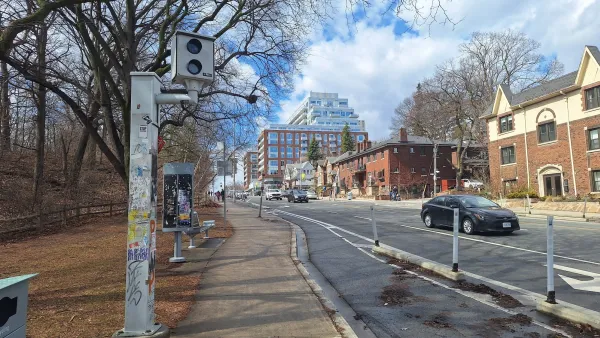
Speeding surges after Ontario cities remove traffic cameras
The province ordered cities to remove the devices despite data that shows they save lives.

Planetizen Federal Action Tracker
A weekly monitor of how Trump’s orders and actions are impacting planners and planning in America.

Amtrak, CN end decades-long dispute with eight-year agreement
The new operating agreement establishes an updated framework for the companies to work together, including processes to resolve disputes.

Nation's most wind-powered state turns to coal as data centers increase energy demand
For the first time in decades, Iowa has increased its generation of coal power.

Alabama scores up to $2.5 billion federal loan for largest infrastructure project in state’s history
The Mobile River Bridge and Bayway Project aims to ease congestion at Alabama’s worst bottleneck.

Trump is considering data centers on 6 states' public land — some state officials say they had no idea
If the administration approves the proposed projects, data center and data center-related developments will cover 17,600 acres of public land.

Despite court ruling, Trump is keeping nearly all wind projects in the US on hold
At least 110 wind energy projects have not heard from the government since a federal judge ruled that the Trump administration's freeze on wind turbine clearances was likely illegal.

FREE Course: Walkable City 1: Why Walkability?
After describing his path towards focusing on walkability as the essence of good planning, Jeff Speck marches through his five principal reasons for making more walkable places.
Reinventing Malls: Planning Alchemy—Turning Gray Fields Into Gold
The course focuses on the opportunities and imperatives that shape reinvention of mall sites.

KFH Group Inc.
Greater Baltimore Committee
Eagle County Government
The Architects Foundation
University of Cincinnati Online
The Pocatello Development Authority
The Urban Renewal Agency of the City of Pocatello