MAP-21 expires on September 30, 2014. The following year, the Highway Trust Fund will be insolvent according to the CBO. Alternatives involve user fees paid by motorists: the gas tax and VMT fee, and two others that bear no connection to driving.


Adam Snider lists the pros and cons of "the most talked-about" options that legislators will consider to pay for the reauthorization or extension of MAP-21. In addition to fiscal urgency, Snider notes that funding the Highway Trust Fund "has gained extra attention with last month’s collapse of an Interstate 5 bridge in Washington state (and) the Metro-North rail crash in Connecticut."
- Raising the fuel excise (per gallon) tax - or following the current trend of moving toward a "percentage tax on wholesale gas prices".
- Vehicle-miles-traveled (VMT) fee.
- Tap oil and natural gas drilling royalties (proposed by Speaker John Boehner in Nov. 2011 and President Obama last March, though for different purposes).
- More transfers from the general fund.
Of the four options, only one has been implemented consistently in recent years.
Transferring money from the general fund to the Highway Trust Fund (HTF) has been the routine over the past few years. It’s how the (three) years of (nine) extensions leading up to MAP-21 were paid for and also offered part of the funding source for last year’s bill. And technically, general fund transfers don’t need an offset.
(S)ince 2008, Congress has shifted $41 billion from the general fund, with another $12.6 billion already authorized for 2014.
Perhaps it's only when all four options are considered that the 'pros' of raising the gas tax stand out as the most practical means to keep the HTF solvent, notwithstanding "a recent Gallup poll (that) found that two-thirds of drivers oppose a gas tax hike, even if the money goes to roads."
- It "can’t be slapped with the fatal “new tax” label — it’s been around for more than 50 years.
- It’s also one of the cheapest taxes to collect, offers little room for fraud and has a proven collection mechanism. Most gas stations would need only a few keystrokes to update their per-gallon price to reflect the increased tax.
- And a strong coalition supports hiking the tax, including some unlikely allies like labor groups and the U.S. Chamber of Commerce. The Chamber rarely supports tax hikes, a point supporters hope to hammer home over the next year.
Another gas tax increase variant would be to index the excise tax as proposed by Rep. Peter DeFazio (D-OR).
Read the full story: Old tax, new fees among options for highway funding

What's Wrong with the Senate's MAP-21 Reauthorization Bill?
Plenty, according to Tanya Snyder, Streetsblog USA editor, who finds Obama's Grow America plan far superior. Outside of not including a gas tax to fill the Trust Fund gap, she finds the proposal "underfunded and highway centric." She is not alone.
Business and Labor Agree: Boost the Gas Tax
At a Senate Environment and Public Works Committee meeting on Feb. 12, leaders from big labor, big business, AASHTO, and AMTRAK testified to the importance of keeping the Highway Trust Fund solvent. The first two specified increasing the gas tax.
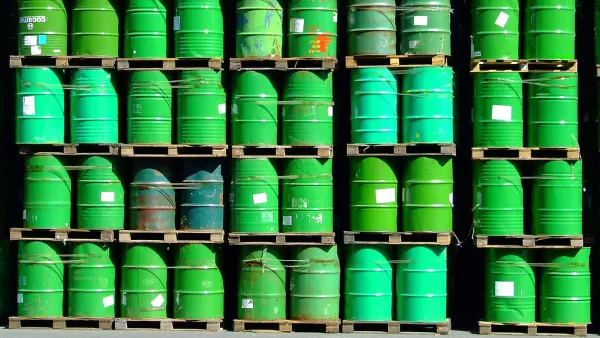
Boxer Proposes Wholesale Oil Tax to Replace Fed. Gas Tax
Taking a cue from states that have introduced new wholesale taxes on fuel that would presumably be passed to the consumer, Sen. Barbara Boxer has proposed replacing the 18.4-cent federal gas tax with an oil sales fee to be paid by oil refineries.

Planetizen Federal Action Tracker
A weekly monitor of how Trump’s orders and actions are impacting planners and planning in America.

Amtrak, CN end decades-long dispute with eight-year agreement
The new operating agreement establishes an updated framework for the companies to work together, including processes to resolve disputes.

Judges permit Denver to divert 77,000 acre feet from the Colorado River for reservoir expansion
Overuse and climate change have caused the Colorado River’s water levels to plummet.

NYC DOT wants faster, more permanent street upgrades
The city is examining ways to build more concrete infrastructure without getting entangled in 'decades-long' projects.

'Something we’ve never seen before:' rising utility rates could strain city finances nationwide
Data centers, climate change and other factors have caused utility rates in the United States to increase by 38% since 2020.

Trump to overrule local leaders, lease millions of acres of America’s Pacific Island territories’ seafloors to mining companies
International law says that the Indigenous people of America’s territories have a right to prior and informed consent regarding projects that impact their countries.

FREE Course: Walkable City 1: Why Walkability?
After describing his path towards focusing on walkability as the essence of good planning, Jeff Speck marches through his five principal reasons for making more walkable places.
Reinventing Malls: Planning Alchemy—Turning Gray Fields Into Gold
The course focuses on the opportunities and imperatives that shape reinvention of mall sites.

Harvard University Graduate School of Design
KFH Group Inc.
Greater Baltimore Committee
The Architects Foundation
University of Cincinnati Online
The Pocatello Development Authority
The Urban Renewal Agency of the City of Pocatello