So said Thomas Donohue, CEO of the world's largest business organization, in calling for raising the gas tax at a press conference following the annual State of American Business address to the U.S. Chamber of Commerce.


Liz Farmer reported on the press conference following the annual address with particular attention on Donohue's recommendation to increase the gas tax.
"A lot of people in the Chamber get a little squishy because a lot of people on [Capital] Hill don't like anything that sounds like a tax,” U.S. Chamber of Commerce President and CEO Thomas Donohue said. “It’s not a tax, it’s a user fee. And if you don’t want to ride on the roads you don’t have to pay for it.”
The CEO of the U.S. Chamber of Commerce has repeated his call to raise the gas tax to replenish the Highway Trust Fund that pays for roads and public transit, funded primarily from fuel taxes. He is not calling for a massive, one-time increase.
“You do a little bit a year for a couple years and it'll make a big difference”, he said.
Earlier this week, a report by Wells Fargo analyst Randy Gerardes noted that a 5 cent increase in the federal gas tax would be sufficient enough to cover the $147 billion funding shortfall that is projected for the transportation fund through 2022.
Since 2008, Congress has been forced to kick in $52.8 billion to patch the sinkhole in the federal highway building fund; states have been forced to spend money from other sources or even turned rural roads from pavement back to gravel to keep maintenance costs down. The U.S. Government Accounting Office says over the next 10 years, the federal road jar will run $110 billion short without changes.
Read the full story: U.S. Chamber Chief Calls for Higher Gas Tax

Road Usage Charge at Least 10 Years Away
Pilot programs are not the real thing, warned Michael Lewis, executive director of the Colorado Department of Transportation, testifying at a House transportation subcommittee on March 7. Colorado completed a successful four-month pilot last April.
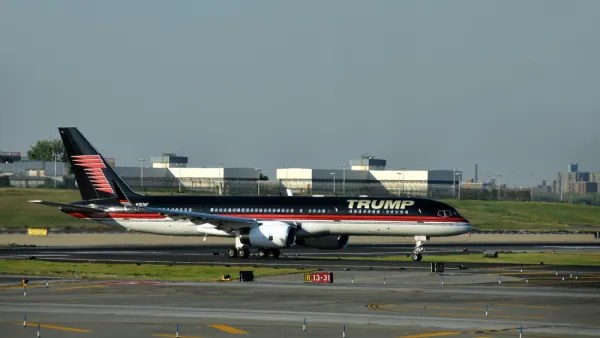
Trump's 25-Cent Infrastructure Tax?
During a closed-door meeting Wednesday with Democratic and Republican lawmakers, President Trump endorsed hiking the gas tax by 25-cents per gallon to help pay for the $200 billion investment and restore solvency to the Highway Trust Fund.
House and Senate Republicans Differ on Must-Pass Transportation Funding Bills
The House passed their patch bill on July 15—it's now the Senate's turn at bat on highway funding. Both houses are controlled by Republicans but they appear to be pitching for different teams. A bill must pass by July 31 or road funding ceases.

Planetizen Federal Action Tracker
A weekly monitor of how Trump’s orders and actions are impacting planners and planning in America.

Amtrak, CN end decades-long dispute with eight-year agreement
The new operating agreement establishes an updated framework for the companies to work together, including processes to resolve disputes.

Judges permit Denver to divert 77,000 acre feet from the Colorado River for reservoir expansion
Overuse and climate change have caused the Colorado River’s water levels to plummet.

NYC DOT wants faster, more permanent street upgrades
The city is examining ways to build more concrete infrastructure without getting entangled in 'decades-long' projects.

'Something we’ve never seen before:' rising utility rates could strain city finances nationwide
Data centers, climate change and other factors have caused utility rates in the United States to increase by 38% since 2020.

Trump to overrule local leaders, lease millions of acres of America’s Pacific Island territories’ seafloors to mining companies
International law says that the Indigenous people of America’s territories have a right to prior and informed consent regarding projects that impact their countries.

FREE Course: Walkable City 1: Why Walkability?
After describing his path towards focusing on walkability as the essence of good planning, Jeff Speck marches through his five principal reasons for making more walkable places.
Reinventing Malls: Planning Alchemy—Turning Gray Fields Into Gold
The course focuses on the opportunities and imperatives that shape reinvention of mall sites.

Harvard University Graduate School of Design
KFH Group Inc.
Greater Baltimore Committee
The Architects Foundation
University of Cincinnati Online
The Pocatello Development Authority
The Urban Renewal Agency of the City of Pocatello