After years of discussions, arguments, and pleas, residents of the Leimert Park neighborhood in South Los Angeles won their battle for the creation of a local stop along a new light rail line soon to start construction.


"After years spent fighting for a light-rail station in Leimert Park, South Los Angeles community members got their wish Thursday with the approval of full funding for a stop in the heart of L.A.'s African American community," reports Laura J. Nelson. "To cheering and applause from dozens of supporters, the Metropolitan Transportation Authority approved $80 million for an underground station in Leimert Park Village along the planned north-south route of the Crenshaw Line."
L.A. County Supervisor Mark Ridley-Thomas, who sponsored the motion that was approved this week, "said the light-rail station, at the intersection of Vernon Avenue and Crenshaw Boulevard, would encourage foot traffic and tourism in the area, which took a hit during the recession."
"'This is a village with a national presence,' Ridley-Thomas said, adding that the area had wide economic and cultural influence. 'This will be a huge shot in the arm.'"
Read the full story: Funding OKd for light-rail station in Leimert Park
Building Capacity in Underserved Urban Areas
Seeing projects through—whether affordable housing, public space, or infrastructure—for low-income populations in cities like Los Angeles requires grit and coalition-building.

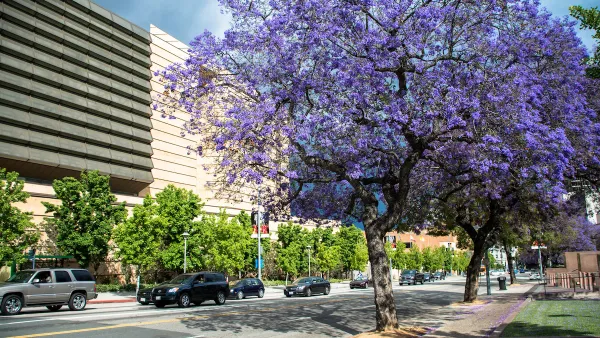
Improving South Los Angeles Through Strategic Tree Planting
The University of Southern California Urban Trees Initiative is planting 250 trees in South L.A. neighborhoods to improve shade, combat climate change, and enhance community well-being through collaboration and data-driven approaches.
Addressing Tree Canopy Disparity in South Los Angeles
A new study highlights the complex challenge of addressing tree canopy disparities in South L.A., where historical environmental injustices, budget constraints, and competing community priorities hinder efforts to increase equitable tree coverage.

Planetizen Federal Action Tracker
A weekly monitor of how Trump’s orders and actions are impacting planners and planning in America.

California plans to bury El Niño’s downpour
If the state plays its cards right, it may be able to store a billion acre-feet of El Niño’s water in aquifers.

Desperate measures: Advocates weigh draining Lake Powell to fill Colorado River
Draining the reservoir could reduce evaporation losses by a couple hundred thousand acre-feet.

Mamdani’s pied-à-terre tax survives legal challenge
A panel of judges found that the plaintiffs failed to demonstrate injury as a result of New York City's implementation of the tax.

Eastern Nebraska is running out of electricity
Data centers and electrification are straining eastern Nebraska’s grid, throttling economic development.

Seattle passes record-breaking transit services expansion
Proposition 1 will double the city’s transit tax to add 95,000 more bus trips and preserve 180,000 bus trips annually.

FREE Course: Walkable City 1: Why Walkability?
After describing his path towards focusing on walkability as the essence of good planning, Jeff Speck marches through his five principal reasons for making more walkable places.
Reinventing Malls: Planning Alchemy—Turning Gray Fields Into Gold
The course focuses on the opportunities and imperatives that shape reinvention of mall sites.

City of Rosemead
Rutgers University, Edward J. Bloustein School of Planning and Public Policy
One Hundred Miles
University of Michigan School for Environment and Sustainability (SEAS)
Hunter College, City University of New York (CUNY)
The Architects Foundation
City of Cambridge
Montrose County
The Pocatello Development Authority