Today, the U.S. is celebrating Bike to Work Day. With increasing investment in bike infrastructure across the country, cycling is becoming a commuting option for more and more workers. Richard Florida looks at the places where it's easiest.


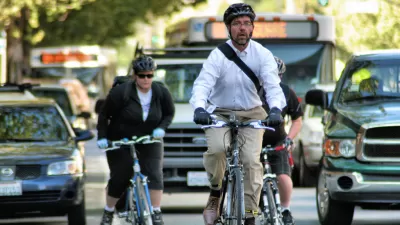
Based on data provided by Bike Score, Florida and his colleagues have identified America's 25 most bikeable neighborhoods and, based on the neighborhood-level data, have mapped the country's most bike-friendly cities. "Six neighborhoods have perfect scores: three in Davis, California, and one each in Madison, Wisconsin; Boulder, Colorado and Eugene, Oregon," reports Florida. "The top-rated city overall is Tucson, with 89 neighborhoods that score 70 or higher, and Minneapolis and Portland tie for second with 61. Albuquerque and Chicago each have 60. Boulder, Sacramento, Davis, New York, and Denver round out the top 10."
If you're interested in more biking data, the folks at Governing have put together an interactive map that examines bicycle commuting trends across the United States. Using data from the 2011 and 2006 American Community Survey, the map shows which cities have seen increases and decreases in the "raw numbers of commuters who primarily bike to work." New York City appears to have the largest increase with 10,253 more commuters using bikes over the 5-year period.
Read the full story: America's Most Bikeable Neighborhoods

How Bike-Friendly Is Your City?
PeopleForBikes just released its annual rankings.
11 Most-Improved Bike Networks in the US
PeopleForBikes has evaluated bike networks in thousands of cities across the United States and identified several that have achieved “incredible increases” in just a few years.
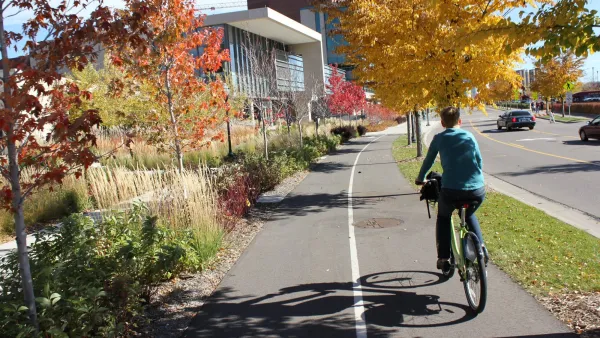
Touring One of the U.S.’s Best Biking Cities: Minneapolis
The latest Streetfilms release offers an in-person, on-bike tour of Minneapolis.

Planetizen Federal Action Tracker
A weekly monitor of how Trump’s orders and actions are impacting planners and planning in America.

California plans to bury El Niño’s downpour
If the state plays its cards right, it may be able to store a billion acre-feet of El Niño’s water in aquifers.

Chicago breaks ground on $3 billion megadevelopment
The new neighborhood, titled Foundry Park, will one day host 3,700 residences.

California High-Speed Rail Authority CEO resigns after $600,000 scandal
Under Ian Choudri, the authority used taxpayer dollars to fund first class flights and trips to nightclubs.

Want to study the Missouri River? Soon, you may need unanimous approval from 10 states
Legislation would require 10 governors’ permission to study or build projects moving water outside the basin.

Desperate measures: Advocates weigh draining Lake Powell to fill Colorado River
Draining the reservoir could reduce evaporation losses by a couple hundred thousand acre-feet.

FREE Course: Walkable City 1: Why Walkability?
After describing his path towards focusing on walkability as the essence of good planning, Jeff Speck marches through his five principal reasons for making more walkable places.
Reinventing Malls: Planning Alchemy—Turning Gray Fields Into Gold
The course focuses on the opportunities and imperatives that shape reinvention of mall sites.

City of Rosemead
Rutgers University, Edward J. Bloustein School of Planning and Public Policy
One Hundred Miles
Hunter College, City University of New York (CUNY)
The Architects Foundation
University of Cincinnati Online
City of Cambridge
Montrose County
The Pocatello Development Authority