For architecture critic Inga Saffron, a $900 million project to improve a South Jersey interchange illustrates the madness of transportation funding priorities.


Sure, a pricey project to reconstruct the "chaotic" Camden County interchange where Interstates 295 and 76 converge with Route 42 should reduce accidents. But for the equivalent of 75 percent of SEPTA's entire annual operating budget, is fixing this problematic interchange the best way to spend increasingly scarce transportation dollars?
The project has Saffron asking tough questions that deserve to be considered: "So, where do we start drawing the line on road costs? Are there times when we should learn to live with jams and delays? Especially since drivers eventually find alternative ways to get around?"
"Transportation advocates hate to compare transit and road projects, since they're financed from different pots of money," she adds. "But this schizoid approach has cost us dearly. No highway project has ever made a city a better place to live, while transit projects improve our quality of life in a variety of ways, and are better for the environment."
With the help of some transit experts, Saffron identifies several potential transit improvements that, for $900 million, could serve many more people.
Read the full story: Changing Skyline: Money for costly roadwork would be better spent on transit

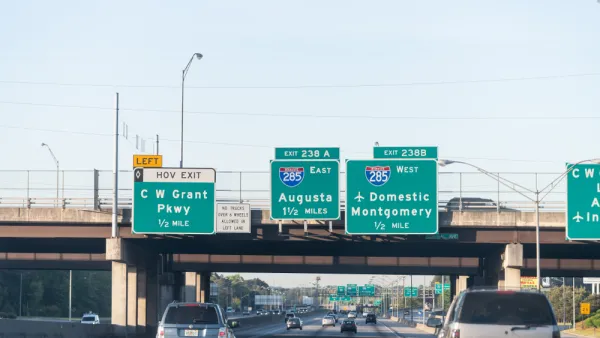
Georgia's $11 Billion Road-Building Program Evolves
Recently announced changes to a massive road-building program in Georgia will shift moves projects aimed at improvements for the trucking industry earlier onto the calendar, while pushing back projects located closer to Atlanta.
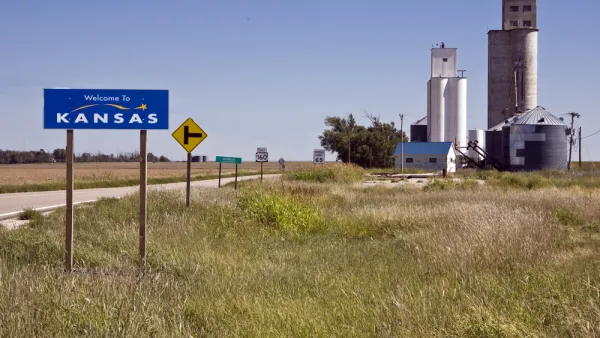
Latest Budget Shortfall Hits Highway Projects in Kansas
In an effort to curb spending by $300 million in the next 15 months, the state of Kansas is considering spending cuts that could hit highway projects and universities. This is the fourth time in two years the state's revenues have fallen short of pro
Hitting Fast-Forward on Transit
LA Mayor Villaraigosa an ambitious new plan to speed up new rail projects throughout the city, and to complete it all within 10 years instead of the previously proposed 30.

Planetizen Federal Action Tracker
A weekly monitor of how Trump’s orders and actions are impacting planners and planning in America.

Amtrak, CN end decades-long dispute with eight-year agreement
The new operating agreement establishes an updated framework for the companies to work together, including processes to resolve disputes.

Judges permit Denver to divert 77,000 acre feet from the Colorado River for reservoir expansion
Overuse and climate change have caused the Colorado River’s water levels to plummet.

NYC DOT wants faster, more permanent street upgrades
The city is examining ways to build more concrete infrastructure without getting entangled in 'decades-long' projects.

'Something we’ve never seen before:' rising utility rates could strain city finances nationwide
Data centers, climate change and other factors have caused utility rates in the United States to increase by 38% since 2020.

Trump to overrule local leaders, lease millions of acres of America’s Pacific Island territories’ seafloors to mining companies
International law says that the Indigenous people of America’s territories have a right to prior and informed consent regarding projects that impact their countries.

FREE Course: Walkable City 1: Why Walkability?
After describing his path towards focusing on walkability as the essence of good planning, Jeff Speck marches through his five principal reasons for making more walkable places.
Reinventing Malls: Planning Alchemy—Turning Gray Fields Into Gold
The course focuses on the opportunities and imperatives that shape reinvention of mall sites.

Harvard University Graduate School of Design
KFH Group Inc.
Greater Baltimore Committee
The Architects Foundation
University of Cincinnati Online
The Pocatello Development Authority
The Urban Renewal Agency of the City of Pocatello