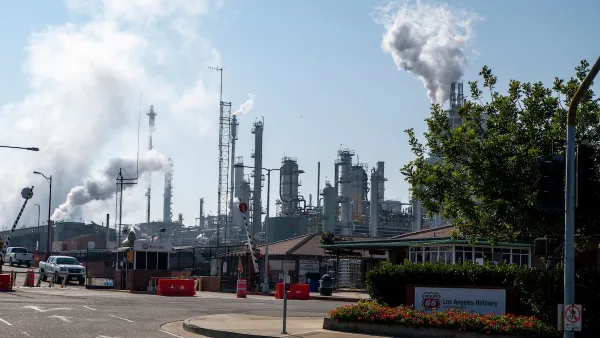
California's second auction saw a 35% increase in the price paid for a carbon pollution permit to $13.62, while prices at the much larger European market continue to fall and permits go unsold. The price there recently fell to $6.46.


Comparisons are difficult because the markets are so different. California sold all of its 12.9 million permits - a permit being the right to emit one metric ton of carbon, while most of the emissions are initially given free to industry. The much older European Union Emissions Trading System (ETS), launched in 2005, auctions hundred of millions of permits.
Lynn Doan writes that "(t)he sale (of the CA auction) was expected to clear at $12.30 a ton, according to a Bloomberg New Energy Finance analysis". The price from the first auction on Nov. 14 price was $10.09.
It looks clearly like a very healthy auction result, at least on the surface,” Lenny Hochschild, head of global carbon trading for broker Evolution Markets in White Plains, New York, said by telephone.
California’s carbon cap-and-trade system is the largest of its kind in the U.S. and the second-biggest carbon market in the world behind the European Union’s. The state, which cites its program as an example for the rest of the world to follow, plans to use it and other emissions-reduction measures to cut greenhouse-gas pollution to 1990 levels by 2020.
Indeed, the California market, which set a minimum price for permits, is being eyed by the ETS, according to Sean Carney, who writes about the "turbulence" the ETS is encountering.
A minimum price (for permits) could prevent another crash, said Divya Reddy, a Washington-based analyst for Eurasia Group who follows climate change. "But from a political perspective it looks unlikely," she added.
Carney writes that "(p)rices for polluting have plummeted, the result of an oversupply of emissions permits in the European carbon-trading market and slackening demand for electricity amid the Continent's economic woes—a development that is calling into question the effectiveness of similar programs world-wide". The relationship between carbon trading and the economic downturn in Europe was reported here last March.
The California program appears to be the exception - as even the East Coast carbon trading program, the Regional Greenhouse Gas Initiative (RGGI) is experiencing difficulties as was reported here. But with only two auctions to date and the economy in recovery, it may be too early to call the program a success. And there's always the lawsuit by the California Chamber of Commerce that could upend the program entirely.
Read the full story: California Carbon Permits Sell Above Expected Clearing Price

California Carbon Trading Program Released - But Election Could Kill It
CA Air Resources Board announced some of the important elements of the carbon trading scheme they developed for the 500 largest stationary emitters in the state. Of course, if Proposition 23 should pass on Nov. 2, forgetaboutit!
California’s Cap and Trade Program Up in the Air
The state’s carbon trading program is being attacked as ineffective from one side and overly onerous from the other.

Host Nation Reveals Embarrassment as Climate Talks End
It's not so easy weaning itself from dirty coal power, one reason why Germany likely won't meet its 2020 greenhouse gas reduction targets. But they will have plenty of company, though all targets are voluntary.

Planetizen Federal Action Tracker
A weekly monitor of how Trump’s orders and actions are impacting planners and planning in America.

Amtrak, CN end decades-long dispute with eight-year agreement
The new operating agreement establishes an updated framework for the companies to work together, including processes to resolve disputes.

Judges permit Denver to divert 77,000 acre feet from the Colorado River for reservoir expansion
Overuse and climate change have caused the Colorado River’s water levels to plummet.

NYC DOT wants faster, more permanent street upgrades
The city is examining ways to build more concrete infrastructure without getting entangled in 'decades-long' projects.

'Something we’ve never seen before:' rising utility rates could strain city finances nationwide
Data centers, climate change and other factors have caused utility rates in the United States to increase by 38% since 2020.

Trump to overrule local leaders, lease millions of acres of America’s Pacific Island territories’ seafloors to mining companies
International law says that the Indigenous people of America’s territories have a right to prior and informed consent regarding projects that impact their countries.

FREE Course: Walkable City 1: Why Walkability?
After describing his path towards focusing on walkability as the essence of good planning, Jeff Speck marches through his five principal reasons for making more walkable places.
Reinventing Malls: Planning Alchemy—Turning Gray Fields Into Gold
The course focuses on the opportunities and imperatives that shape reinvention of mall sites.

Harvard University Graduate School of Design
KFH Group Inc.
Greater Baltimore Committee
The Architects Foundation
University of Cincinnati Online
The Pocatello Development Authority
The Urban Renewal Agency of the City of Pocatello