Updating the U.S.'s aging infrastructure requires legislative common sense, says Rep. Bill Shuster.


The U.S. Chamber of Commerce supports a federal gas tax increase to pay for roads, bridges and mass transit. An alternative would be to charge drivers user fees, which would be lower than the gas tax, to avoid penalizing idling during congestions and incentivise better planning.
According to studies by the American Society of Civil Engineers, the United States needs to make a $2.7 trillion investment in transportation infrastructure by the year 2020 to maintain its global competitive edge.
Ashley Halsey III reports on the conlusions of a panel representing business, union and state government interests that appeared before the Republican-led House Transportation and Infrastructure Committee. The group unanimously agreed that the problem of aging infrastructure should not be left up to individual municipalities, counties or states.
The committee's Chair Rep. Bill Shuster (R-Pa) called for using common sense in the upcoming legislative sessions, which will oversee surface transportation, ports and inland waterways and railroads bills with the first set to expire in 2014.
Read the full story: At hearing on nation’s crumbling infrastructure, money is the theme
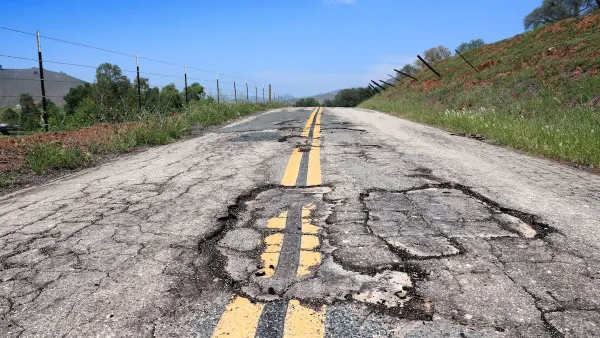
Engineers Gave America's Roads an Almost Failing Grade — Why Aren't We Fixing Them?
With over a trillion dollars spent on roads that are still falling apart, advocates propose a new “fix it first” framework.

Minnesota Dam Failure Highlights Nationwide Danger
The Rapidan Dam isn’t the only one at risk of imminent failure.
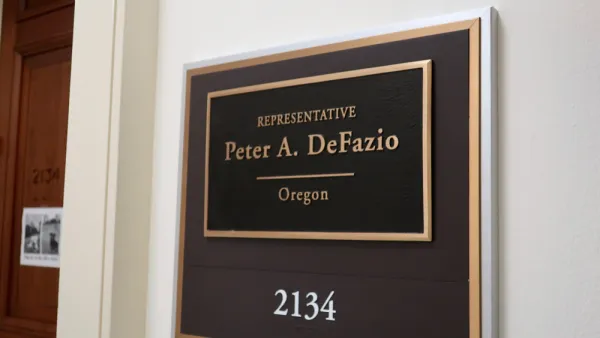
Peter De Fazio, Chair of the House Transportation and Infrastructure Committee, to Retire
The end of an era for Oregon in Congress.

Planetizen Federal Action Tracker
A weekly monitor of how Trump’s orders and actions are impacting planners and planning in America.

Eastern Nebraska is running out of electricity
Data centers and electrification are straining eastern Nebraska’s grid, throttling economic development.

Move over, LA: St. Louis gears up for Olympics, invests millions in downtown redevelopment
The Missouri city will host the 2028 Olympic soccer group stage and knockout matches.

Dallas releases zoning code overhaul to officials
The drafted overhaul is over 400 pages long.

NYC renovations for dangerous, ‘mercilessly crammed’ street delayed until 2027
Construction was supposed to begin this fall.

San Diego’s Midway Rising project gets greenlight from city council
The project looks to become the largest affordable housing development in California's history.

FREE Course: Walkable City 1: Why Walkability?
After describing his path towards focusing on walkability as the essence of good planning, Jeff Speck marches through his five principal reasons for making more walkable places.
Reinventing Malls: Planning Alchemy—Turning Gray Fields Into Gold
The course focuses on the opportunities and imperatives that shape reinvention of mall sites.

City of Rosemead
Rutgers University, Edward J. Bloustein School of Planning and Public Policy
One Hundred Miles
University of Michigan School for Environment and Sustainability (SEAS)
Hunter College, City University of New York (CUNY)
The Architects Foundation
City of Cambridge
The Pocatello Development Authority
The Urban Renewal Agency of the City of Pocatello