The Rapidan Dam isn’t the only one at risk of imminent failure.


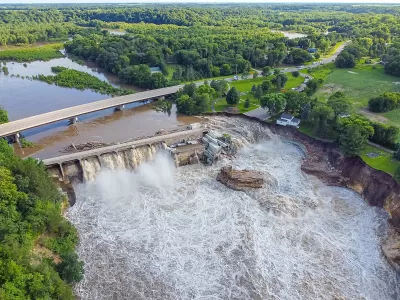
In an article for the Washington Post, Michael Goldberg describes the failure of the Rapidan Dam near Mankato, Minnesota, which partly collapsed on Monday, causing power outages and damage including at least one destroyed home. “Water levels peaked Monday at 34,800 cubic feet per second, and Blue Earth County officials issued an imminent threat warning. Those figures make this flood the second largest in the dam’s history,” Goldberg notes.
The failure wasn’t a shock to local officials. Even prior to the dam experiencing one of its highest floods on record later that year, a 2019 assessment found that a failure of the dam would result in property loss.
“After the 2019 flood, ice jams formed in a narrow bend of the river downstream of the dam from January through March 2020. These jams continued to build and caused water to rise and flood, a 2021 study found.” A 2023 assessment of the dam, which was built in 1910, found it in “poor condition.”
“Aging, unsafe dams are ticking time bombs,” the article notes. As Goldberg explains, “Dams are often built to last 50 years, and like other infrastructure, they deteriorate with age.” Dams like the Rapidan around the country are aging far beyond their projected lifespan, putting downstream communities in danger.
Read the full story: What happened to Minnesota's Rapidan Dam? Here's what to know about its flooding and partial failure
Climate Change in Action: Massive Storms, Dam Failures
The dam failures that sent residents of Michigan scrambling last week can be connected to the extreme weather events created by climate change, according to experts.
Dams Break in Michigan: Nation's Crumbling Infrastructure Takes Center Stage Again
Reports of catastrophic infrastructure failure today in Michigan, a state already facing some of the worst consequences of the Covid-19 pandemic.
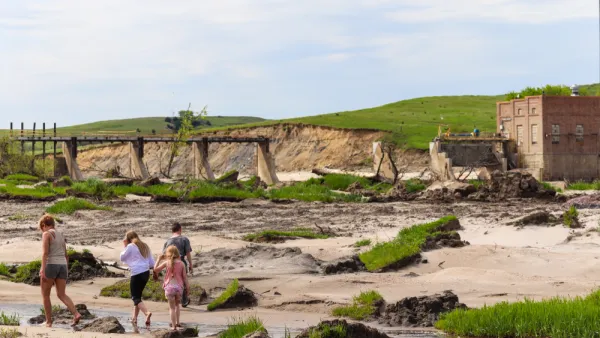
The U.S. of Breaking and Broken Dams
New analysis of high-hazard dams reveals the ubiquity, and risks, of the infrastructure challenges facing the United States.

Planetizen Federal Action Tracker
A weekly monitor of how Trump’s orders and actions are impacting planners and planning in America.

California plans to bury El Niño’s downpour
If the state plays its cards right, it may be able to store a billion acre-feet of El Niño’s water in aquifers.

Desperate measures: Advocates weigh draining Lake Powell to fill Colorado River
Draining the reservoir could reduce evaporation losses by a couple hundred thousand acre-feet.

Chicago voters approve permanent festival grounds, penalty for vacant property owners
Currently, major summer and fall festivals take over public parks for weeks at a time, drawing criticism from nearby residents

NYC votes to cut outdoor dining red tape, speed up permitting
New York City also voted to allow the Department of Transportation to begin work on urgent projects before notifying elected officials.

California appears to reject Prop. 45
The proposition would have expanded the projects that qualify for a streamlined environmental review, effectively paring down the California Environmental Quality Act.

FREE Course: Walkable City 1: Why Walkability?
After describing his path towards focusing on walkability as the essence of good planning, Jeff Speck marches through his five principal reasons for making more walkable places.
Reinventing Malls: Planning Alchemy—Turning Gray Fields Into Gold
The course focuses on the opportunities and imperatives that shape reinvention of mall sites.


City of Rosemead
Rutgers University, Edward J. Bloustein School of Planning and Public Policy
One Hundred Miles
Hunter College, City University of New York (CUNY)
The Architects Foundation
University of Cincinnati Online
City of Cambridge
Montrose County
The Pocatello Development Authority