Seven years after Katrina made mincemeat of the city's flood protections, Hurricane Isaac is bearing down on the Crescent City. Ingrid Norton looks at what's different this time around.


Although only a Category 1 storm at this point (Katrina struck as a Category 3), Hurricane Isaac is predicted to deliver a direct hit to New Orleans late tonight or early tomorrow in the largest test yet for the city's flood defenses, rebuilt at a cost of $14 billion.
According to Norton, "The oncoming storm is also a test for Mayor Mitch Landrieu, who was
elected in 2010 with a broad mandate to reform the city's legendarily
dysfunctional bureaucracy and modernize its infrastructure, including
emergency communication systems and transit systems necessary for
evacuation proceedings."
"So far, Landrieu appears to be winning the confidence of colleagues in
government as well as residents who say his improvements, such as
upgrades to the city's 311 system, are helping keep panic levels low. In
stark contrast to his predecessor Ray Nagin, who had a skittish
relationship to the public throughout his two terms in office -
including, infamously, during Katrina - Landrieu has maintained clear
and consistent communication throughout the buildup to the storm, with
his staff live-tweeting press conferences and issuing emergency warnings in Spanish and Vietnamese."
Read the full story: Daily Seven Years After Katrina, Isaac Tests a Stronger New Orleans

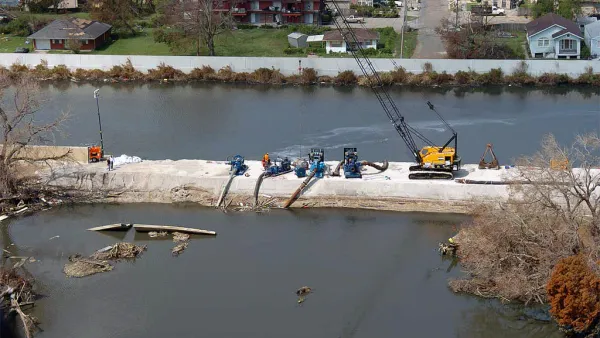
Report: $14 Billion New Orleans Flood System, Completed Less Than a Year Ago, Already Obsolete
The Army Corps of Engineers is already assessing the needs of repair work on a project it completed in May 2018 at the cost of $14 billion.
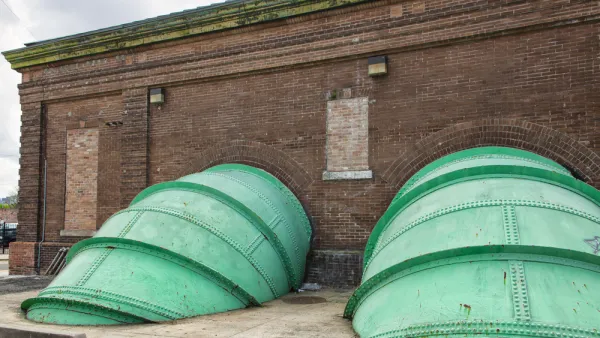
Hurricane Nate to Test New Orlean's Drainage System
Nate will make landfall southeast of New Orleans on Saturday night as possibly a category 2 hurricane after leaving at least 22 dead in Central America. It's not so much the levees but the pumps and generators that have city officials worried.

20 Years After Katrina, New Orleans is More Unaffordable Than Ever
The city’s post-hurricane redevelopment has failed to include its most vulnerable residents.

Planetizen Federal Action Tracker
A weekly monitor of how Trump’s orders and actions are impacting planners and planning in America.

Amtrak, CN end decades-long dispute with eight-year agreement
The new operating agreement establishes an updated framework for the companies to work together, including processes to resolve disputes.

Judges permit Denver to divert 77,000 acre feet from the Colorado River for reservoir expansion
Overuse and climate change have caused the Colorado River’s water levels to plummet.

NYC DOT wants faster, more permanent street upgrades
The city is examining ways to build more concrete infrastructure without getting entangled in 'decades-long' projects.

'Something we’ve never seen before:' rising utility rates could strain city finances nationwide
Data centers, climate change and other factors have caused utility rates in the United States to increase by 38% since 2020.

Trump to overrule local leaders, lease millions of acres of America’s Pacific Island territories’ seafloors to mining companies
International law says that the Indigenous people of America’s territories have a right to prior and informed consent regarding projects that impact their countries.

FREE Course: Walkable City 1: Why Walkability?
After describing his path towards focusing on walkability as the essence of good planning, Jeff Speck marches through his five principal reasons for making more walkable places.
Reinventing Malls: Planning Alchemy—Turning Gray Fields Into Gold
The course focuses on the opportunities and imperatives that shape reinvention of mall sites.

Harvard University Graduate School of Design
KFH Group Inc.
Greater Baltimore Committee
The Architects Foundation
University of Cincinnati Online
The Pocatello Development Authority
The Urban Renewal Agency of the City of Pocatello