Nate will make landfall southeast of New Orleans on Saturday night as possibly a category 2 hurricane after leaving at least 22 dead in Central America. It's not so much the levees but the pumps and generators that have city officials worried.


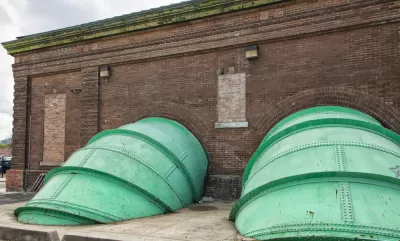
Even without hurricanes, the city's stormwater infrastructure is stressed, illustrated by an August 5 storm left parts of the city deluged. It became clear that "even if the entire pumping system had been operating at maximum capacity […] the rain would still have overwhelmed the system," according to an Aug. 10 report in the Guardian posted here.
"The core of the storm could make landfall Saturday night around Plaquemines Parish in Louisiana, where Hurricane Katrina, a Category 3 hurricane that devastated New Orleans and the Mississippi Gulf Coast, hit in 2005," reports CNN at 6:22 PM ET on Oct. 7.
"No hurricane has made landfall in Louisiana since 2012, when Hurricane Isaac moved ashore near the mouth of the Mississippi River," report Katy Reckdahl and Alan Blinder for The New York Times on Friday. "Mississippi has gone even longer without a hurricane landfall: Its last was Katrina."
With the latest storm approaching, a handful of pumps are still inoperable, and city officials said they had made arrangements to monitor and staff all [120] pumping stations. Even with additional personnel, supported by National Guard troops who were deployed to New Orleans ahead of the storm, the city will still face the challenge of running the system without a fully functioning network of steam turbines that provide power.
They are likely to have little choice but to shut off some pumps in order to turn on others where the flooding could be more severe.
How well, or poorly, the pumps and other parts of the stormwater infrastructure operate will be a reflection on outgoing Mayor Mitch Landrieu who "has spent his waning months in office coping with the city’s drainage troubles." He urged residents not to drive as streets will be flooded, imposed a curfew effective Saturday night and ordered evacuations in some parts of the city.
Now Mr. Landrieu’s makeshift, rapidly developed response will be tested, as will the team he appointed to deal with the drainage problems. The system has, so far, shown signs of improvement. Still, after a rainstorm went over New Orleans on Monday, several cars were mired in knee-deep water.
"A hurricane warning was in effect for parts of Alabama, Louisiana and Mississippi, and the authorities posted a hurricane watch for a stretch of the Florida Panhandle," add Reckdahl and Blinder.
"Life-threatening storm surge is expected along the coast tonight from southeast Louisiana to the western Florida Panhandle," reports The Weather Channel at 8:30 PM ET.
The Globe and Mail reported on Oct. 5 that Nate caused at least 15 deaths in Nicaragua and seven in Costa Rica.
FULL STORY: Now a Hurricane, Nate Is Aiming for Gulf Coast

Louisianans Flee Coast As Hurricane Hits Land
With Hurricane Gustav reaching land Monday, nearly 2 million people have been evacuated from coastal Louisiana. The evacuation is being hailed as a vast improvement from the effort three years ago during Hurricane Katrina, but some residents remain.
Hurricane Ian Puts Renewed Focus on Florida's Barrier Islands
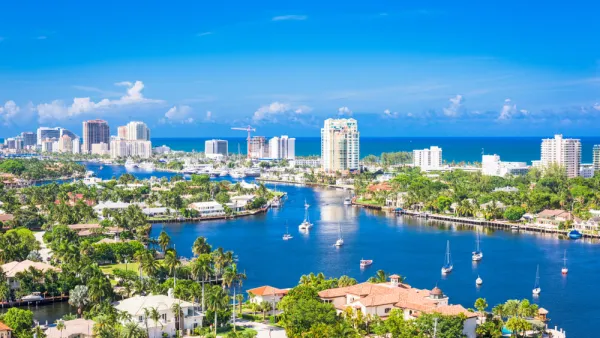
Ian did not impact Southeast Florida, but coastal residents there took notice of the state's deadliest hurricane since 1935 that devastated much of Southwest Florida last month, particularly the barrier islands off the Gulf Coast.

Miami Beach: A Four-Foot High Barrier Island Awaited Irma
A city of almost 92,000 people sits on a one-mile wide island designed by nature to protect the mainland from ocean swells, storms, and hurricanes. The seven-mile long island, which floods even when sunny, was spared from catastrophic storm surge.

The state-sanctioned urbicide of Austin
People don’t kill cities. Freeways do.

US to reduce Colorado River water deliveries to Mexico
A new Colorado Treaty amendment reduces Mexico’s Colorado River water allocation by 250,000 acre feet.

New Jersey’s second-largest city bans standalone data centers
Jersey City will continue to allow co-location facilities, such as those meant for research institutions that store their own data.

Amtrak not solely to blame for New Jersey commuter rail's unreliability, report finds
A new study from the Garden State Initiative found that NJ Transit’s budget grew 20% across a 4 year period, but reliability declined significantly over the same period.

EPA erases limits on planet-warming pollution from power plants
Under Monday’s plan, power plants would still have some limits on how much mercury, arsenic and other contaminants they can emit.

Phoenix announces new on-demand transit service, more frequent RAPID buses
Both new services will launch in October, and are part of Phoenix's Project Effective Access Solutions for Easing Congestion.

FREE Course: Walkable City 1: Why Walkability?
After describing his path towards focusing on walkability as the essence of good planning, Jeff Speck marches through his five principal reasons for making more walkable places.
Reinventing Malls: Planning Alchemy—Turning Gray Fields Into Gold
The course focuses on the opportunities and imperatives that shape reinvention of mall sites.

Eagle County Government
Harvard University Graduate School of Design
Nashville Planning Department
The Architects Foundation
University of Cincinnati Online
The Pocatello Development Authority
The Urban Renewal Agency of the City of Pocatello
Journal of the American Planning Association