Jeff McMahon explores the potential of passenger rail in coming years as automobiles and airplanes "become a little more obsolete."


Transportation officials from three major cities – Chicago, Denver, and Washington, D.C. – came together last week to discuss how to spruce up U.S. transit centers. At the center of that discussion was a consensus that Americans will soon look to the train station first when traveling from one city to another – or, as McMahon puts it, "that U.S. transit centers are about to become much more crowded."
Former Amtrak CEO Tom Downs offered the insight that "highways and aviation... are capacity constrained [and] capital starved, and there is not much in the way of optimism about either of them. Your capacity seems to be pretty much unlimited for rail."
Chicago's Department of Transportation, for example, anticipates its train traffic will increase 40 percent over the next thirty years; Denver's light rail system has exceeded its ridership projections since it opened in 1994.
"And railroads can accommodate dramatic increases in traffic more easily than highways or aviation."
Read the full story: U.S. Poised For Passenger Rail Boom
Learning loss and urban schools, part 2
Did test scores in progressive cities drop more post-COVID than test scores in moderate ones?
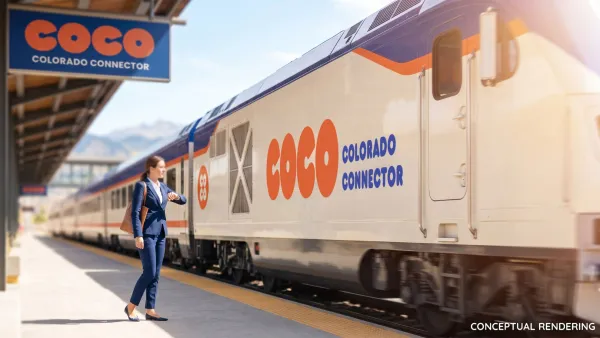
Colorado unveils fox mascot, branding for 'CoCo' high-speed rail
The new Denver-to-Fort Collins train is expected to begin service in 2029.
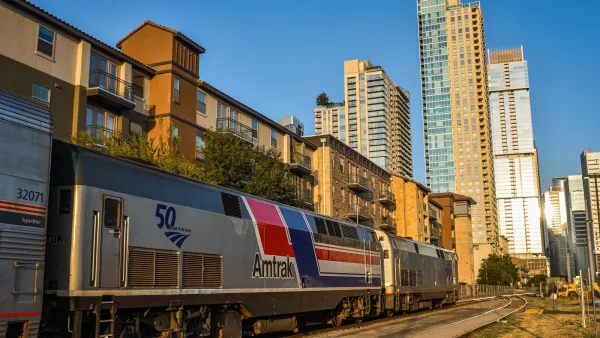
Texas DOT report outlines options for commuter rail between Austin and San Antonio
Amtrak currently operates just one trip per day between the two cities.

Planetizen Federal Action Tracker
A weekly monitor of how Trump’s orders and actions are impacting planners and planning in America.

Eastern Nebraska is running out of electricity
Data centers and electrification are straining eastern Nebraska’s grid, throttling economic development.

Study reveals best places in the U.S. for cycling, walking
New research from Streetlight Data examines bicycle and pedestrian miles per capita in the 100 largest U.S. cities by population.

DSA members accuse Mamdani of 'abandoning values' over housing redevelopment
New York City's mayor plans to replace about 2,000 units of public housing with private, mixed-income housing.

All sides of BRT debate unhappy with CDOT’s most recent move
The Colorado Department of Transportation is no longer considering center-running bus lanes for Colorado Boulevard.

Massachusetts bogs generate both power, and cranberries
Putting solar panels above farmland is one way Massachusetts is advancing toward its goal of net-zero carbon emissions by 2050.

FREE Course: Walkable City 1: Why Walkability?
After describing his path towards focusing on walkability as the essence of good planning, Jeff Speck marches through his five principal reasons for making more walkable places.
Reinventing Malls: Planning Alchemy—Turning Gray Fields Into Gold
The course focuses on the opportunities and imperatives that shape reinvention of mall sites.

City of Rosemead
Rutgers University, Edward J. Bloustein School of Planning and Public Policy
One Hundred Miles
University of Michigan School for Environment and Sustainability (SEAS)
Hunter College, City University of New York (CUNY)
The Architects Foundation
City of Cambridge
The Pocatello Development Authority
The Urban Renewal Agency of the City of Pocatello