According to Yonah Freemark, the FTA announced that with a "New Starts grant," the 9.4-mile bus rapid transit line that has been under consideration since the late 90's, has finally secured funds to complete the project.


The New Britain-Hartford busway will connect the capital of Connecticut and New Britain. The grant funds "will cover about half of the project's $567 million cost; construction of the segregated right-of-way and 11 stations will begin next year, with completion expected in 2014."
"The busway, expected to carry a total of 16,000 passengers a day - 5,000 of whom will be new to transit - will feature all of the elements crucial to a good BRT project, including off-board fare-collection, level boarding, signal priority at intersections, and next bus arrival information at well-outfitted stations."
The project is meeting opposition by other groups including The Sierra Club. The Sierra Club, known for their pro-transit position, claim that "the busway's construction will make future rail expansion in Connecticut far more difficult."
Read the full story: Now Funded, Hartford’s Busway Survives a Decade of Dissent
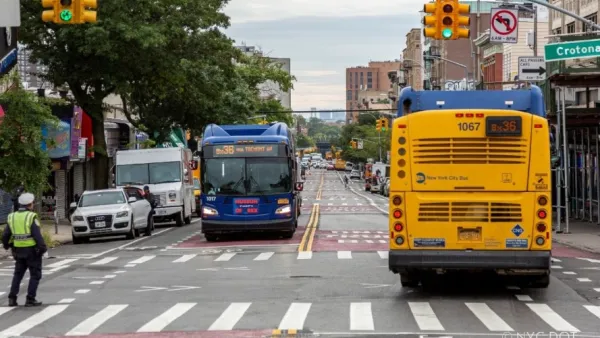
Buses travel at 5mph along this route in NYC. The Bronx's first-ever busway looks to change that
Prior to the busway, buses on the Bx36 route traveled as slowly as 5 miles per hour.
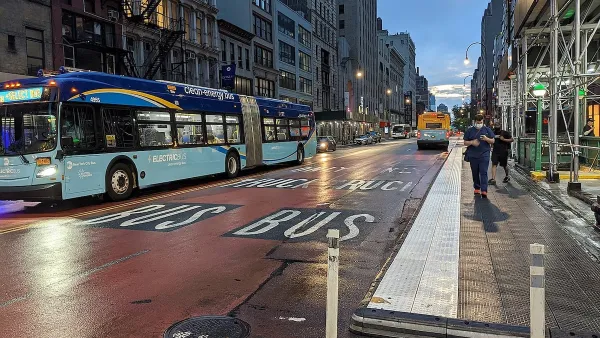
NYC Politicians, Public Rally in 'Outrage' to Save Bus Lane Killed by Trump
City officials say the project complies with all applicable laws and should go forward as planned.
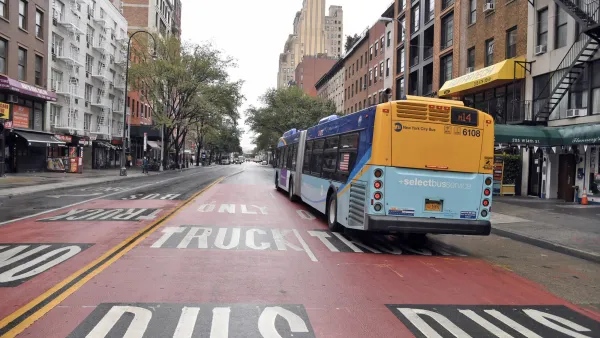
Is N.Y.C.’s 14th Street Busway the Future of Transportation?
The success of the busway project could point to a longer-term shift away from planning and design strategies that favor cars.

Planetizen Federal Action Tracker
A weekly monitor of how Trump’s orders and actions are impacting planners and planning in America.

Eastern Nebraska is running out of electricity
Data centers and electrification are straining eastern Nebraska’s grid, throttling economic development.

Study reveals best places in the U.S. for cycling, walking
New research from Streetlight Data examines bicycle and pedestrian miles per capita in the 100 largest U.S. cities by population.

Federal government nominates new FTA administrator
Mark Aesch is currently the founder and CEO of a transportation management consulting firm.

Developers reveal $10 billion stadium plan as ‘Hail Mary’ to keep Bears in Chicago
The plan would also boast a public park, high- and mid-rise buildings and a youth sports complex.

As Texas embraces carbon storage, a Black community questions the risks
Texas now issues permits for companies to store carbon dioxide underground. East Texas residents fear safety risks, and skeptics doubt the climate benefits.

FREE Course: Walkable City 1: Why Walkability?
After describing his path towards focusing on walkability as the essence of good planning, Jeff Speck marches through his five principal reasons for making more walkable places.
Reinventing Malls: Planning Alchemy—Turning Gray Fields Into Gold
The course focuses on the opportunities and imperatives that shape reinvention of mall sites.

City of Rosemead
Rutgers University, Edward J. Bloustein School of Planning and Public Policy
One Hundred Miles
University of Michigan School for Environment and Sustainability (SEAS)
Hunter College, City University of New York (CUNY)
The Architects Foundation
City of Cambridge
The Pocatello Development Authority
The Urban Renewal Agency of the City of Pocatello