The Transport Politic details the City of New York's plans for a citywide busway on 34th Street.


Despite little money in its transportation coffers, the city analyzed a variety of transit options for the 34th Street corridor. This piece looks at why the busway was selected.
"It's sometimes worth considering the hoops through which transit agencies must jump in order to bring their visions to fruition.
But the alternatives analysis did allow New York City's DOT to demonstrate why it considers a dedicated transitway for bus service to be the ideal technology candidate for the two-mile 34th street corridor, running river to river. The mode allows the use of existing vehicles and the through-routing of express buses from elsewhere in the city - something not possible had streetcars or light rail been chosen. It would also be relatively cheap to implement, at between $30 and 125 million, versus $250 million and up for light rail or several billion for a full-scale subway line.
The transitway would allow commuters to get across the city 35% faster than possible today, cutting transit times to 20 minutes, just slightly longer than would be feasible with a light rail line."
Read the full story: New York Plans Transitway on 34th Street, but It's Not BRT, for Better or Worse

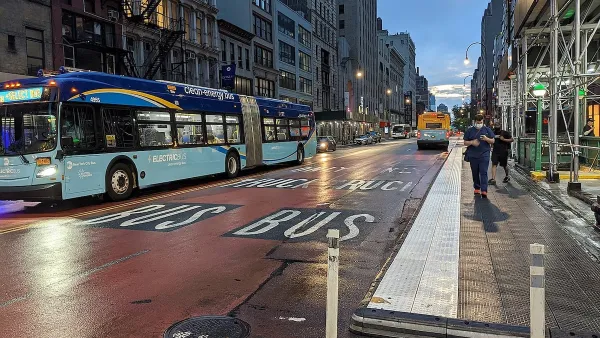
NYC Politicians, Public Rally in 'Outrage' to Save Bus Lane Killed by Trump
City officials say the project complies with all applicable laws and should go forward as planned.
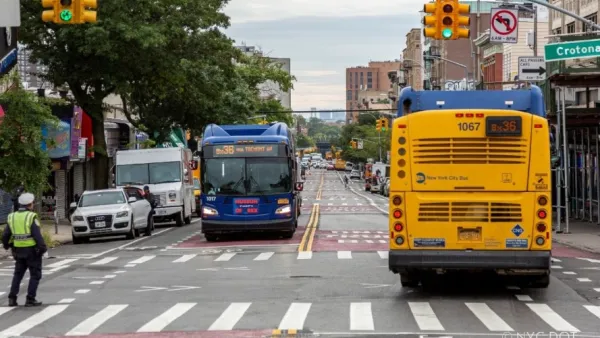
Buses travel at 5mph along this route in NYC. The Bronx's first-ever busway looks to change that
Prior to the busway, buses on the Bx36 route traveled as slowly as 5 miles per hour.
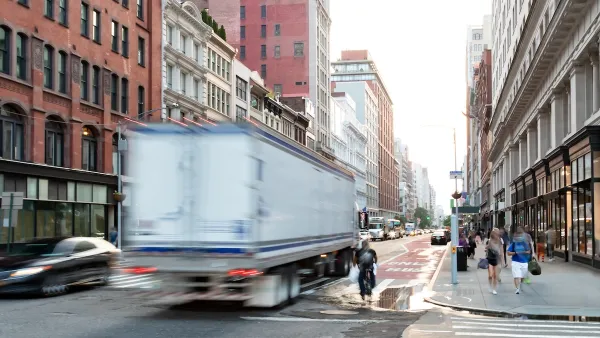
NYC Truckers Join Fight Against Trump's Bus Lane Removal
An industry group is denying the FHA’s claim that a proposed bus lane would hamper delivery trucks and freight.

Planetizen Federal Action Tracker
A weekly monitor of how Trump’s orders and actions are impacting planners and planning in America.

California plans to bury El Niño’s downpour
If the state plays its cards right, it may be able to store a billion acre-feet of El Niño’s water in aquifers.

Chicago breaks ground on $3 billion megadevelopment
The new neighborhood, titled Foundry Park, will one day host 3,700 residences.

California High-Speed Rail Authority CEO resigns after $600,000 scandal
Under Ian Choudri, the authority used taxpayer dollars to fund first class flights and trips to nightclubs.

Want to study the Missouri River? Soon, you may need unanimous approval from 10 states
Legislation would require 10 governors’ permission to study or build projects moving water outside the basin.

Desperate measures: Advocates weigh draining Lake Powell to fill Colorado River
Draining the reservoir could reduce evaporation losses by a couple hundred thousand acre-feet.

FREE Course: Walkable City 1: Why Walkability?
After describing his path towards focusing on walkability as the essence of good planning, Jeff Speck marches through his five principal reasons for making more walkable places.
Reinventing Malls: Planning Alchemy—Turning Gray Fields Into Gold
The course focuses on the opportunities and imperatives that shape reinvention of mall sites.

City of Rosemead
Rutgers University, Edward J. Bloustein School of Planning and Public Policy
One Hundred Miles
Hunter College, City University of New York (CUNY)
The Architects Foundation
University of Cincinnati Online
City of Cambridge
Montrose County
The Pocatello Development Authority