The newly formed Alameda County Transportation Commission is proposing a permanent, half-cent sales tax be placed on before the voters of the second most populous Bay Area county for the Nov. 2012 ballot for a variety of transportation purposes.


Should the measure be approved by a 2/3 vote, Alameda would join Los Angeles as the only CA counties with dedicated transportation county sales taxes - this is in addition to any transit district taxes, such as the half-cent BART sales tax that Alameda, Contra Costa, and San Francisco Counties pay. There is controversy among county transit advocates though about the transit portion (44%) of the proposed sales tax:
"A coalition of social justice and public transit advocates said the $400 million for BART to Livermore (extension) would be better spent on restoring bus service.
"To ensure that B3 (the tax increase) is successful, it must equitably invest in sustaining our existing transportation system and not increase the share of tax dollars being funneled to costly, low-benefit expansion projects," the coalition said in a statement (Nov. 13) made to a transportation commission steering committee.
In sharp disagreement, dozens of Livermore residents packed the Thursday meeting in Oakland to speak out for the rail extension funds."
"Local roads and streets would receive 30 percent. Trails and other projects to improve pedestrian and bicycle transportation would get 5 percent."
The current county transportation 1/2 cent sales tax expires 2022. Should B3 appear on the Nov. ballot, it may accompany a regional (9-county) gas tax of up to 10-cent gallon for transportation, primarily public transit.
Thanks to Climate Plan
Read the full story: Alameda County commission proposes ballot measure to increase sales tax for transportation

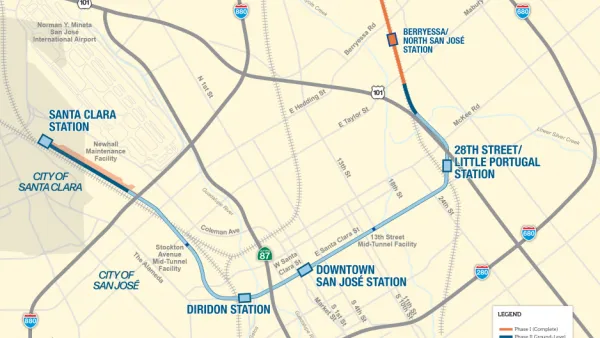
BART’s Phase II Extension Into San Jose Ready to Go
A long-awaited extension of the Bay Area’s regional rail transit system is finally coming into view, with an expected completion date of 2030.
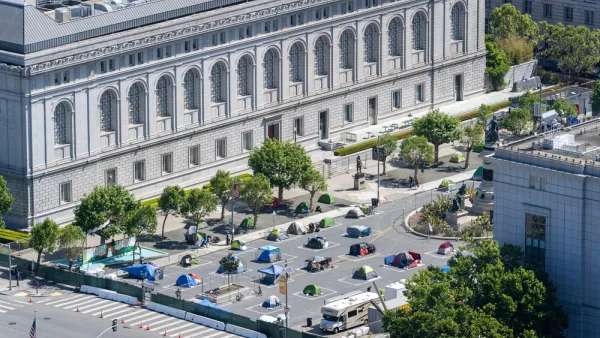
Number of Unhoused People Lower in San Francisco, but Growing Across the Bay Area
While the city saw fewer people experiencing homelessness for the first time in years, homelessness across six Bay Area counties grew by 8 percent.
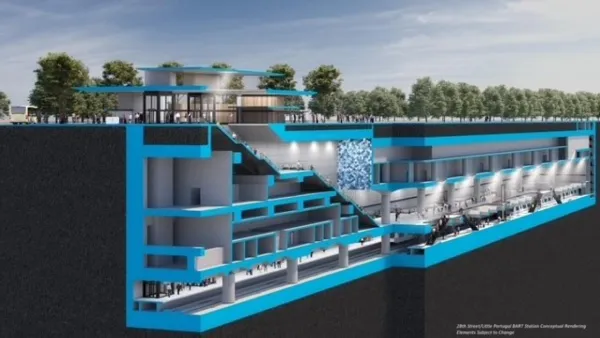
San Jose Bart Extension Could Be Delayed Until 2034, Increase in Cost by $4.4 Billion
A report attained by the Mercury News uncovers information regarding the BART Silicon Valley Phase II Project that will come as a surprise to anyone paying attention to recent federal support for the project.

Planetizen Federal Action Tracker
A weekly monitor of how Trump’s orders and actions are impacting planners and planning in America.

Amtrak, CN end decades-long dispute with eight-year agreement
The new operating agreement establishes an updated framework for the companies to work together, including processes to resolve disputes.

Judges permit Denver to divert 77,000 acre feet from the Colorado River for reservoir expansion
Overuse and climate change have caused the Colorado River’s water levels to plummet.

NYC DOT wants faster, more permanent street upgrades
The city is examining ways to build more concrete infrastructure without getting entangled in 'decades-long' projects.

'Something we’ve never seen before:' rising utility rates could strain city finances nationwide
Data centers, climate change and other factors have caused utility rates in the United States to increase by 38% since 2020.

Trump to overrule local leaders, lease millions of acres of America’s Pacific Island territories’ seafloors to mining companies
International law says that the Indigenous people of America’s territories have a right to prior and informed consent regarding projects that impact their countries.

FREE Course: Walkable City 1: Why Walkability?
After describing his path towards focusing on walkability as the essence of good planning, Jeff Speck marches through his five principal reasons for making more walkable places.
Reinventing Malls: Planning Alchemy—Turning Gray Fields Into Gold
The course focuses on the opportunities and imperatives that shape reinvention of mall sites.

Harvard University Graduate School of Design
KFH Group Inc.
Greater Baltimore Committee
The Architects Foundation
University of Cincinnati Online
The Pocatello Development Authority
The Urban Renewal Agency of the City of Pocatello