It's the opposite of conventional transportation policy in American cities that places motorist convenience in high priority (think 'level of service'). This story shows what European cities are doing to get motorists out of cars.


"The methods vary, but the mission is clear - to make car use expensive and just plain miserable enough to tilt drivers toward more environmentally friendly modes of transportation".
While 'smart transportation policy' in U.S. cities now includes smarter parking pricing policies, many European cities are eliminating street parking. And congestion (cordon) pricing has yet to appear in the U.S. despite showing excellent results in London and Stockholm.
"In the United States, there has been much more of a tendency to adapt cities to accommodate driving," said Peder Jensen, head of the Energy and Transport Group at the European Environment Agency. "Here there has been more movement to make cities more livable for people, to get cities relatively free of cars."
No project appears too small - even removing "pedestrian underpasses that once allowed traffic to flow freely across major intersections have been removed", adding to what Americans call 'traffic delay'.
Read the full story: Across Europe, Irking Drivers Is Urban Policy

A Market Urbanism Manifesto
In his new book on market urbanism, Scott Beyer describes market urbanism and to compares it to the status quo.
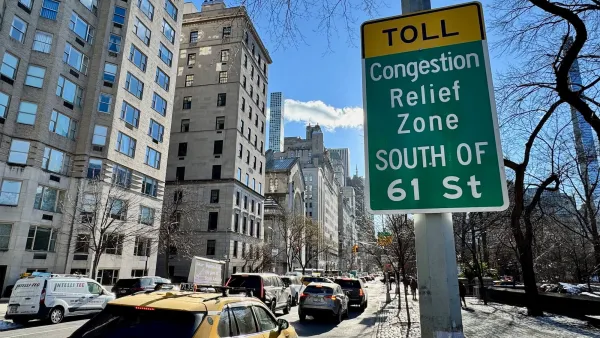
Study: NYC congestion pricing didn't impact parking demand
A city report shows that free parking, not congestion pricing, is the main driver of limited parking demand in the city.
The Urbanist Case Against Congestion Pricing
And why it is wrong.

Planetizen Federal Action Tracker
A weekly monitor of how Trump’s orders and actions are impacting planners and planning in America.

California plans to bury El Niño’s downpour
If the state plays its cards right, it may be able to store a billion acre-feet of El Niño’s water in aquifers.

Chicago breaks ground on $3 billion megadevelopment
The new neighborhood, titled Foundry Park, will one day host 3,700 residences.

Satanic Place Names
From streams and lakes to valleys and canyons, I mapped more than 1,000 places named after the Devil.

California High-Speed Rail Authority CEO resigns after $600,000 scandal
Under Ian Choudri, the authority used taxpayer dollars to fund first class flights and trips to nightclubs.

Want to study the Missouri River? Soon, you may need unanimous approval from 10 states
Legislation would require 10 governors’ permission to study or build projects moving water outside the basin.

FREE Course: Walkable City 1: Why Walkability?
After describing his path towards focusing on walkability as the essence of good planning, Jeff Speck marches through his five principal reasons for making more walkable places.
Reinventing Malls: Planning Alchemy—Turning Gray Fields Into Gold
The course focuses on the opportunities and imperatives that shape reinvention of mall sites.

City of Rosemead
Rutgers University, Edward J. Bloustein School of Planning and Public Policy
One Hundred Miles
Hunter College, City University of New York (CUNY)
The Architects Foundation
University of Cincinnati Online
City of Cambridge
Montrose County
The Pocatello Development Authority