Free street parking in much of New York City means lost revenue, but it also affects the urban landscape and the quality of people’s lives. So how much is all that street space really worth?


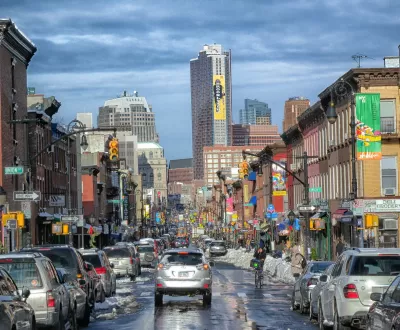
Justin Fox crunches the numbers to calculate the cost of free parking in New York City. Fox uses various measures, including median income, the cost of added congestion, and land prices. "These calculations were far from scientific, but the narrow range of results they delivered makes me think that a street parking space in Manhattan may really be worth somewhere between $6,000 and $8,500 a year," says Fox.
The cost and true value of parking are of special interest now because congestion pricing in the lower half of Manhattan is slated to start next year, notes Fox. Free parking will be harder to come by as people look for ways to avoid the fees, and the impacts on surrounding neighborhoods, such as increases in congestion as drivers hunt for parking spaces, will only become more apparent.
Fox cites a report from the staff of Manhattan Borough president Gale Brewer that looks at parking policies in seven cities. It suggests that the number of permits needs to be limited and the cost of permits should be high, though these policies would not necessarily need to be applied uniformly across the city. "But in a borough where fewer than 25% of households have cars, and those that do are almost twice as affluent as those that don’t, giving away for free something that appears to be worth more than $6,000 a year doesn’t make a lot of sense," adds Fox.
FULL STORY: How Much Should New York Charge for a Parking Space? A Lot

Parking Battles Heat Up in New York City
With car ownership rates soaring, the fight for the city's free street parking spots is intensifying.
N.Y.C. Parking Reform Takes Step Forward as Debate Rages On
In Manhattan, a contentious debate has been brewing over on-street parking and how that space could be used for something other than storing cars.
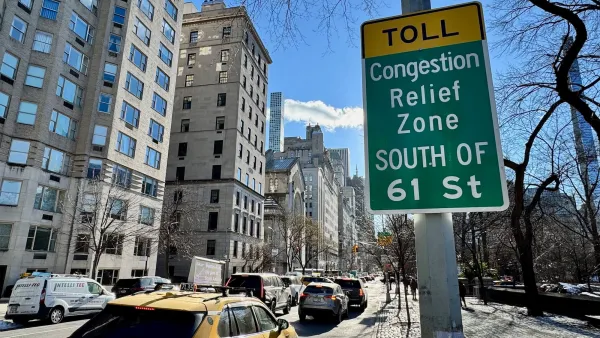
Study: NYC congestion pricing didn't impact parking demand
A city report shows that free parking, not congestion pricing, is the main driver of limited parking demand in the city.

The state-sanctioned urbicide of Austin
People don’t kill cities. Freeways do.

US to reduce Colorado River water deliveries to Mexico
A new Colorado Treaty amendment reduces Mexico’s Colorado River water allocation by 250,000 acre feet.

New Jersey’s second-largest city bans standalone data centers
Jersey City will continue to allow co-location facilities, such as those meant for research institutions that store their own data.

Amtrak not solely to blame for New Jersey commuter rail's unreliability, report finds
A new study from the Garden State Initiative found that NJ Transit’s budget grew 20% across a 4 year period, but reliability declined significantly over the same period.

EPA erases limits on planet-warming pollution from power plants
Under Monday’s plan, power plants would still have some limits on how much mercury, arsenic and other contaminants they can emit.

Phoenix announces new on-demand transit service, more frequent RAPID buses
Both new services will launch in October, and are part of Phoenix's Project Effective Access Solutions for Easing Congestion.

FREE Course: Walkable City 1: Why Walkability?
After describing his path towards focusing on walkability as the essence of good planning, Jeff Speck marches through his five principal reasons for making more walkable places.
Reinventing Malls: Planning Alchemy—Turning Gray Fields Into Gold
The course focuses on the opportunities and imperatives that shape reinvention of mall sites.

Eagle County Government
Harvard University Graduate School of Design
Nashville Planning Department
The Architects Foundation
University of Cincinnati Online
The Pocatello Development Authority
The Urban Renewal Agency of the City of Pocatello
Journal of the American Planning Association