Suburban areas are increasingly in the sights of planners and designers who are thinking of new ways to reform the sprawled out land use patterns. This interview looks at how those efforts relate to Houston.


Sustainable development experts Galina Tachieva and Tom Low talk about the problems faced in the suburbs of Houston and the rest of the U.S.
"Galina: In Houston there are many examples of places which are entirely auto-oriented. We call them sprawl patterns. And they're actually typical, not only for Houston, they're typical and normative and standard for the rest of the country. And so we believe that some of these places have out-lived their kind of life. And it would be much better if they are turned into mix-use and walkable places. Right now they are single use.
Wendy: Why is that better?
Galina: Because these places - single family residential developments, or the typical malls, shopping centers, office parks - they are single-use, very auto-oriented, separated pods of development. And they need to be rebalanced with different uses so people can walk to destinations."
Read the full story: De-Sprawling Houston
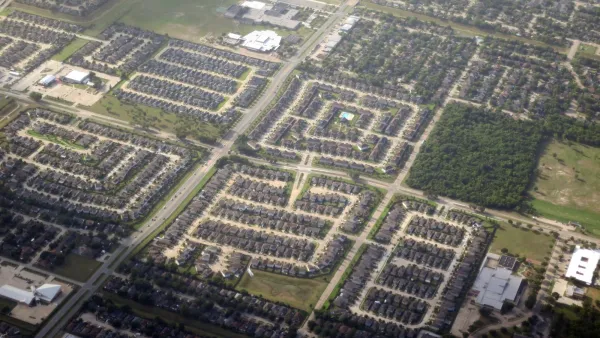
Houston Area's Center of Gravity Shifts Outside the Loop
The population center of Harris County is now outside central Houston, a shift that occurred over the last two decades as the region's suburbs blossomed.
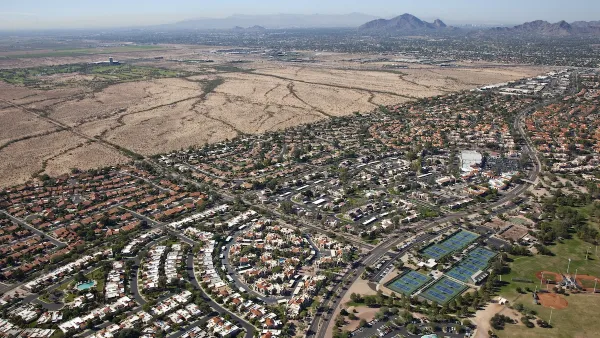
Nearly Half a Million New Arizona Homes Halted Due to Water Crisis
The Arizona Department of Water Resources has put a moratorium on new water supply permits, making the future of planned residential developments uncertain.

The Nation’s 40 Fastest-Growing Suburbs
Projected population growth will be concentrated in suburban communities around major metropolitan areas, with the Sunbelt experiencing the fastest growth.

Planetizen Federal Action Tracker
A weekly monitor of how Trump’s orders and actions are impacting planners and planning in America.

Eastern Nebraska is running out of electricity
Data centers and electrification are straining eastern Nebraska’s grid, throttling economic development.

Study reveals best places in the U.S. for cycling, walking
New research from Streetlight Data examines bicycle and pedestrian miles per capita in the 100 largest U.S. cities by population.

Next-generation nuclear reactors are coming to Texas
The reactors will not require towering containment structures thanks to new safety features.

California distributes $1.3 billion to prevent transit service cuts, bolster projects
Twenty-eight projects across California received a portion of the funding.

Pennsylvania Democrats have 15 affordability, clean energy bills for flipped state Senate
Bills in consideration include a bill supporting geothermal energy and a bill supporting solar on warehouses.

FREE Course: Walkable City 1: Why Walkability?
After describing his path towards focusing on walkability as the essence of good planning, Jeff Speck marches through his five principal reasons for making more walkable places.
Reinventing Malls: Planning Alchemy—Turning Gray Fields Into Gold
The course focuses on the opportunities and imperatives that shape reinvention of mall sites.

City of Charlotte
City of Rosemead
Rutgers University, Edward J. Bloustein School of Planning and Public Policy
University of Michigan School for Environment and Sustainability (SEAS)
Hunter College, City University of New York (CUNY)
The Architects Foundation
City of Cambridge
The Pocatello Development Authority
The Urban Renewal Agency of the City of Pocatello