The population center of Harris County is now outside central Houston, a shift that occurred over the last two decades as the region's suburbs blossomed.


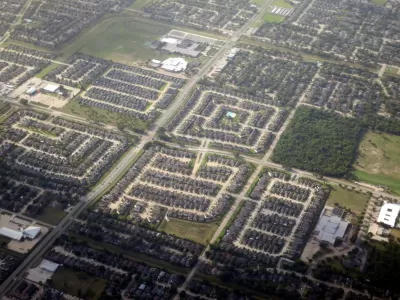
For the first time in the city's history, Harris County's population center has moved away from the downtown Houston loop, signaling that the decentralization characteristic to the sprawling metropolis has finally shifted the center of gravity of the region itself. As Matt Dulin writes, "The center of Harris County now falls right along West 34th Street near Ella Boulevard on the edge of the Oak Forest neighborhood—a suburb from another era of expansion, making it an appropriate nod to the city’s past and the region’s future."
Houston's population has grown by around 40 percent since the turn of the 21st century, with growth concentrated in suburbs in the northwestern part of Harris County. According to Dulin, the region has seen the most suburban and exurban growth of the top five metropolitan statistical areas in the U.S. "To put it another way: The Houston MSA’s population outside Houston city limits grew 7 times faster than the city itself."
With plenty of available land and high demand for planned suburban communities, experts expect that outward development in the Houston region will continue. But Dulin notes that the central city has experienced its own redevelopment, and the rising values of homes in neighborhoods like Oak Forest indicate a strong interest in living near downtown—if the city can provide the amenities that make urban neighborhoods safe and livable.
This year, developers are expected to break ground on a slew of major projects in both central and suburban Houston, including the new headquarters of Hewlett Packard Enterprise and a 28-story downtown office tower.
FULL STORY: After 20 years, the center of Harris County's population has moved outside the Loop


First Model Homes Revealed in Disney-Built Community
Disney’s Cotino, in the Southern California desert, is the first of the company’s ‘Storybook Living’ developments.

Promoting Infill Development for a Denser Houston
An advocacy group is calling for ‘sustainable, vertical’ mixed-use urbanism in the famously sprawling city.
The Changing Shape of American Suburbs
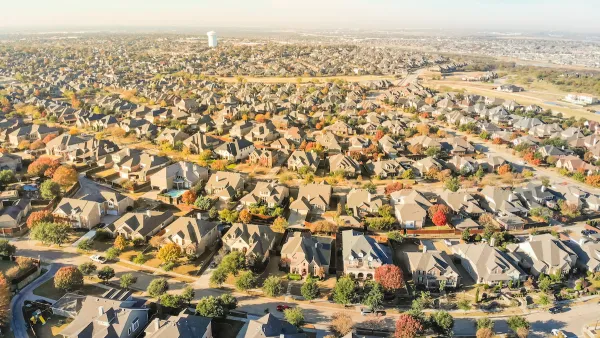
Housing costs and availability are pushing more American households, including young families, to suburbs and exurbs — and they’re demanding changes.

Planetizen Federal Action Tracker
A weekly monitor of how Trump’s orders and actions are impacting planners and planning in America.

The state-sanctioned urbicide of Austin
People don’t kill cities. Freeways do.

US to reduce Colorado River water deliveries to Mexico
A new Colorado Treaty amendment reduces Mexico’s Colorado River water allocation by 250,000 acre feet.

5 New England states march closer to 800 megawatt wind energy project
Securing federal approval for the project may be complicated under the Trump administration, which has historically been hostile towards domestic wind power.

Baltimore to break ground on $50 million Transit Priority Project
The project will bring faster bus trips, safer streets and better bike connections to Baltimore.

Airbnb launches $250 million 'last-dollar financing' housing accelerator, makes first investment in Austin
The company will put $6.4 million towards affordable housing development in Texas’ capital.

FREE Course: Walkable City 1: Why Walkability?
After describing his path towards focusing on walkability as the essence of good planning, Jeff Speck marches through his five principal reasons for making more walkable places.
Reinventing Malls: Planning Alchemy—Turning Gray Fields Into Gold
The course focuses on the opportunities and imperatives that shape reinvention of mall sites.

Eagle County Government
Harvard University Graduate School of Design
Nashville Planning Department
The Architects Foundation
University of Cincinnati Online
The Pocatello Development Authority
The Urban Renewal Agency of the City of Pocatello
Journal of the American Planning Association