The Post's transit reporter looks at the substantial MTA budget shortfall resulting in major service reductions and fare increases, but one MTA board member regrets the state senate's refusal to do away with the 'free ride' to Manhattan.


The 'free ride' is for motorists who drive across the East and Harlem Rivers. The fees and taxes, including a regional payroll tax, that the legislature did approve in 2009 are falling short of their revenue projections.
"The riders have done their part with service cuts and fare hikes, but motorists aren't doing their part," fumed Andrew Albert, an Metropolitan Transportation Authority (MTA) board member. He added that the bailout bill "is not a good package" and that city's free bridges should be tolled to help finance mass transit."
From Streetsblog: Road Pricing Still the Big Missing Piece in MTA Funding Puzzle: " Tolls on the East and Harlem River bridges were supposed to be part of the deal - getting car commuters who benefit from the congestion-busting effect of transit to contribute their fair share. But the State Senate insisted on preserving the free ride for motorists."
Thanks to Streetsblog New York City
Read the full story: Watch the gap! MTA hit by tax shortfalls

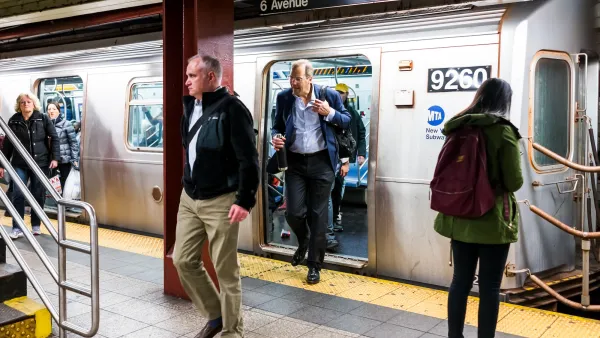
NYC to Upgrade 1/3 of its Subway Car Fleet
The MTA is seeking proposals for up to 2,390 new subway cars to upgrade its aging fleet.
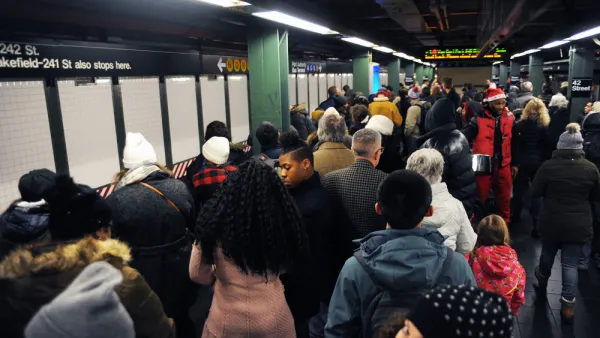
NYC Transit Needs Its Commuters Back
With ridership still at less than half of pre-pandemic levels, the region's transit agencies face billions of dollars in budget shortfalls after federal assistance runs out.
Destroyed Subway Car Windows Contribute to MTA Budget Deficit
As the Metropolitan Transportation Authority grapples with a $16 billion deficit, smashed train windows are adding to the cost.

Planetizen Federal Action Tracker
A weekly monitor of how Trump’s orders and actions are impacting planners and planning in America.

Amtrak, CN end decades-long dispute with eight-year agreement
The new operating agreement establishes an updated framework for the companies to work together, including processes to resolve disputes.

Judges permit Denver to divert 77,000 acre feet from the Colorado River for reservoir expansion
Overuse and climate change have caused the Colorado River’s water levels to plummet.

Boston has spent millions making the Green Line more accessible — and there’s no end in sight
While the city has invested millions into expanding and adding platforms to the Green Line to make it more accessible, new train cars set to arrive next year will be too tall for disabled passengers to board without raising the current platforms.

Idaho may see an 18% drop in federal surface transit funding — the largest estimated cut in the US
Transit systems in rural communities are much more reliant on federal funding to provide their services.

How ‘post-disaster gentrification’ alters neighborhoods after natural calamities
After hurricanes, fires or other calamities, the original residents of a community are often replaced by younger, wealthier residents.

FREE Course: Walkable City 1: Why Walkability?
After describing his path towards focusing on walkability as the essence of good planning, Jeff Speck marches through his five principal reasons for making more walkable places.
Reinventing Malls: Planning Alchemy—Turning Gray Fields Into Gold
The course focuses on the opportunities and imperatives that shape reinvention of mall sites.

Harvard University Graduate School of Design
KFH Group Inc.
Greater Baltimore Committee
The Architects Foundation
University of Cincinnati Online
The Pocatello Development Authority
The Urban Renewal Agency of the City of Pocatello