Recent MTA budget cuts have forced New York City to axe a few of its bus routes, but they've had the effect of spurring a new wave of private bus initiatives.


Market Urbanism breaks down the economics at play.
"Now that's not to say that private operators haven't tried to compete – the outer boroughs' immigrant communities have had robust networks of informal private vans (known in NYC as "dollar vans"), which operate illegally but have been hard to prosecute, likely due to the fact that they are used mostly by linguistically-distinct immigrant communities. The recent cuts even propelled the bootleg bus phenomenon out of its immigrant ghetto, when a brave bus operator named Joel Azumah made headlines by operating a bootleg bus route along routes cut in Manhattan, Queens, and Brooklyn. This experiment was quickly quashed by an unrelenting bureaucracy, but at least it demonstrated the mutual desire on the part of riders and entrepreneurs for private service.
The city's Taxi and Limousine Commission appears to have headed that call, and under the direction of chairman David Yassky is trying to replace at least some of the old bus routes with private buses. Unlike the city's much-abused private van service, where operators are technically not allowed to pick up riders off the street who haven't called ahead of time, the buses would operate with many of the privileges of regular city buses, with the added flexibility of being able to alter their routes to fit customers' needs. Cap'n Transit has speculated that this discretion could be used as a back-door way to expand the private buses' reach to areas not officially sanctioned by the program.
"
Thanks to Stephen Smith
Read the full story: Private buses make a comeback in NYC

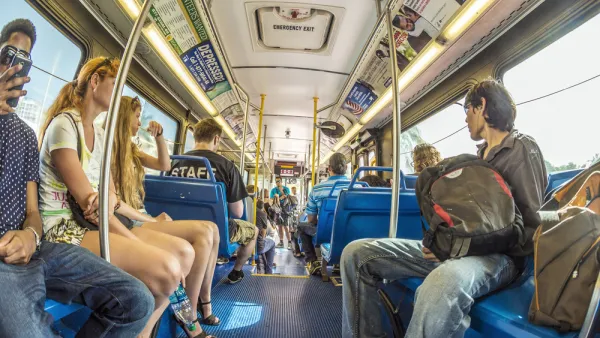
To Fight Climate Change, Support Public Transit
Electric cars may garner a lot of attention these days, but significantly reducing carbon emissions and urban congestion means investing in high-quality mass transit.
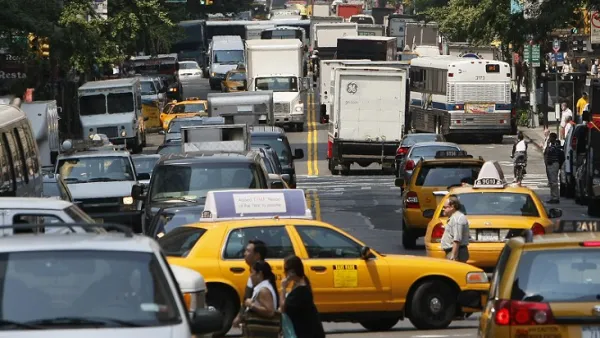
New York Mayor's 'Gridlock Alerts' Go Unheeded
Mobility advocates say the city must do more to make transit and alternative transportation modes more convenient for drivers.
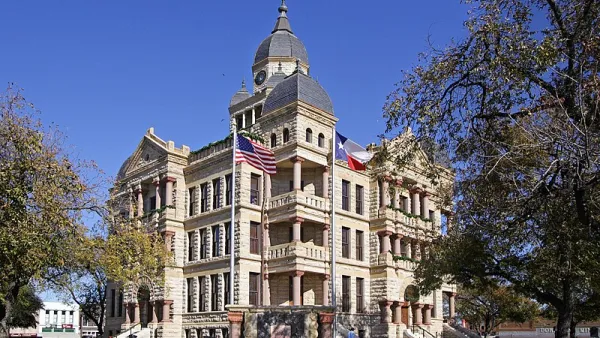
Denton Plans to Replace Most Bus Routes With On-Demand Microtransit
Transit advocates worry that outsourcing fixed-route service will decrease service levels and raise costs for riders.

Planetizen Federal Action Tracker
A weekly monitor of how Trump’s orders and actions are impacting planners and planning in America.

Amtrak, CN end decades-long dispute with eight-year agreement
The new operating agreement establishes an updated framework for the companies to work together, including processes to resolve disputes.

Judges permit Denver to divert 77,000 acre feet from the Colorado River for reservoir expansion
Overuse and climate change have caused the Colorado River’s water levels to plummet.

NYC DOT wants faster, more permanent street upgrades
The city is examining ways to build more concrete infrastructure without getting entangled in 'decades-long' projects.

'Something we’ve never seen before:' rising utility rates could strain city finances nationwide
Data centers, climate change and other factors have caused utility rates in the United States to increase by 38% since 2020.

Trump to overrule local leaders, lease millions of acres of America’s Pacific Island territories’ seafloors to mining companies
International law says that the Indigenous people of America’s territories have a right to prior and informed consent regarding projects that impact their countries.

FREE Course: Walkable City 1: Why Walkability?
After describing his path towards focusing on walkability as the essence of good planning, Jeff Speck marches through his five principal reasons for making more walkable places.
Reinventing Malls: Planning Alchemy—Turning Gray Fields Into Gold
The course focuses on the opportunities and imperatives that shape reinvention of mall sites.

Harvard University Graduate School of Design
KFH Group Inc.
Greater Baltimore Committee
The Architects Foundation
University of Cincinnati Online
The Pocatello Development Authority
The Urban Renewal Agency of the City of Pocatello