Delayed from implementation for four years, San Francisco's bicycle plan has been legally ruled into action. The first lanes are being painted.


The first lanes are now being used in the city, where litigation and court-ordered environmental reviews had delayed implementation.
"[I]t carries the distinction of being the first bike lane painted in San Francisco after a Superior Court judge late Friday gave the city permission to fully implement its bike plan that had been held up by litigation for four years.
The city can now move ahead with plans to add 31 miles of new lanes to the 48 miles already striped.
The court intervened in response to a lawsuit filed by the Coalition for Adequate Review and Ninety-Nine Percent, which are led by blogger Rob Anderson. He demanded that before the bike enhancements proceed, the city conduct an environmental impact report to study, in particular, the effects of removing parking and traffic lanes to accommodate bike lanes."
Read the full story: Long-delayed bike plan gets going with new lane
New Bike Lanes Proposed in San Francisco
Officials in San Francisco are floating a plan that would add 34 more miles of bike lanes to the city, nearly doubling its current stock. The addition would require the removal of street parking and could take over some traffic lanes.
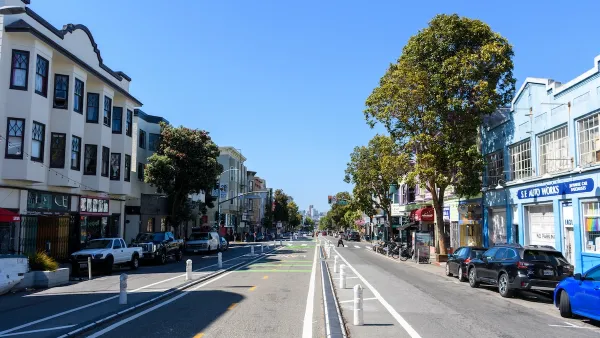
How San Francisco’s ‘People Protected Bike Lanes’ are Moving the Needle on Road Safety
A local bike safety protest has become a global phenomenon.
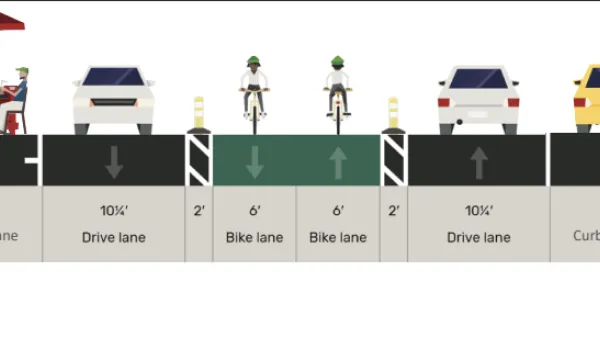
Center-Running Bike Lane Pilot Project Approved on Dangerous S.F. Street
A plan to reconfigure Valencia Street between 15th and 23rd streets in San Francisco has been approved despite stiff opposition from community members and bike advocates.

Planetizen Federal Action Tracker
A weekly monitor of how Trump’s orders and actions are impacting planners and planning in America.

Eastern Nebraska is running out of electricity
Data centers and electrification are straining eastern Nebraska’s grid, throttling economic development.

Washington state to charge fee to drivers with fuel-efficient cars
Revenue from the fee will go towards supporting the state’s highways.

Instead of building new housing, LA developers are turning mansions into mega-mansions
In the richest areas, the number of houses valued at $30 million with demolition permits has skyrocketed since 2018.

Illinois considers spending $1 billion in taxpayer money on data center
A quantum computing campus and data center are currently under construction in Chicago.

As development costs rise, Boston moves to lessen affordable housing requirements
The Boston Zoning Commission and the City Council still need to approve Boston Mayor Michelle Wu’s proposed changes

FREE Course: Walkable City 1: Why Walkability?
After describing his path towards focusing on walkability as the essence of good planning, Jeff Speck marches through his five principal reasons for making more walkable places.
Reinventing Malls: Planning Alchemy—Turning Gray Fields Into Gold
The course focuses on the opportunities and imperatives that shape reinvention of mall sites.

City of Charlotte
City of Rosemead
Rutgers University, Edward J. Bloustein School of Planning and Public Policy
University of Michigan School for Environment and Sustainability (SEAS)
Hunter College, City University of New York (CUNY)
The Architects Foundation
University District Partnership
City of Cambridge
The Pocatello Development Authority