The manufacturing industry is rapidly growing in Brooklyn. But unlike the black smokestacks of the past, this new industrial revolution is both green and high-tech.


Metropolis looks at the growing manufacturing industry in Brooklyn, and how those industries are also acting as community builders.
"And then there's the Brooklyn Navy Yard, a 300-acre site on the East River, established by the U.S. Navy in 1801. Since 1966, when the Navy pulled out, it's been a city-owned industrial zone. Sitting on what is now prime real estate, just across the river from Manhattan, the Navy Yard contains a fascinating mix of about 240 businesses, only a couple of which have anything to do with ships. There's Crye American, a young company that managed to snag a defense contract to make Kevlar body armor; Steiner Studios, the largest soundstage on the East Coast; and Cumberland Packing, the company that invented Sweet & Low. There are also artisans-metal- and woodworkers, set builders, display makers-who straddle the boundary between art and industry. The Navy Yard, according to Andrew Kimball, its president, is energetically rebranding itself as a 'sustainable industrial park,' home to America's first 'multistory, green industrial facility,' the newly completed, 89,000-square-foot, LEED-certified Perry Building."
Read the full story: Made in Brooklyn


Carbon Emissions Down, but Not Drastically
Transportation activity is down considerably, but other sources of carbon dioxide are still going strong.
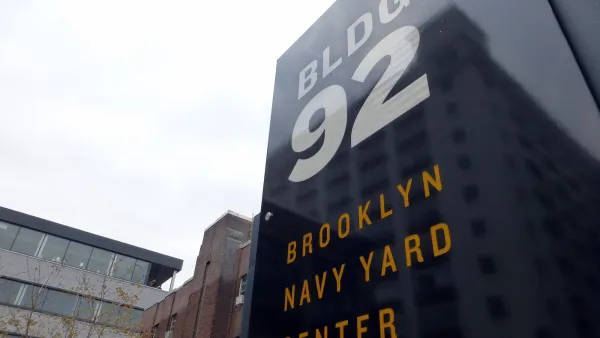
New Master Plan Envisions Brooklyn Navy Yard as Next-Gen Manufacturing Hub
Brooklyn Navy Yard Development Corporation's master plan for the site is a $2.5 billion bet that high-tech manufacturers can be enticed back to New York, bringing with them the economic heft to transform the whole area.
The de Blasio Administration Stays Firm on Waterfront Rezonings
Despite its ambitious housing targets, the de Blasio Administration isn't willing to sacrifice more of its prime industrial spaces, and the jobs they bring, in the name of residential development.

Planetizen Federal Action Tracker
A weekly monitor of how Trump’s orders and actions are impacting planners and planning in America.

California plans to bury El Niño’s downpour
If the state plays its cards right, it may be able to store a billion acre-feet of El Niño’s water in aquifers.

Chicago breaks ground on $3 billion megadevelopment
The new neighborhood, titled Foundry Park, will one day host 3,700 residences.

California High-Speed Rail Authority CEO resigns after $600,000 scandal
Under Ian Choudri, the authority used taxpayer dollars to fund first class flights and trips to nightclubs.

Want to study the Missouri River? Soon, you may need unanimous approval from 10 states
Legislation would require 10 governors’ permission to study or build projects moving water outside the basin.

Desperate measures: Advocates weigh draining Lake Powell to fill Colorado River
Draining the reservoir could reduce evaporation losses by a couple hundred thousand acre-feet.

FREE Course: Walkable City 1: Why Walkability?
After describing his path towards focusing on walkability as the essence of good planning, Jeff Speck marches through his five principal reasons for making more walkable places.
Reinventing Malls: Planning Alchemy—Turning Gray Fields Into Gold
The course focuses on the opportunities and imperatives that shape reinvention of mall sites.

City of Rosemead
Rutgers University, Edward J. Bloustein School of Planning and Public Policy
One Hundred Miles
Hunter College, City University of New York (CUNY)
The Architects Foundation
University of Cincinnati Online
City of Cambridge
Montrose County
The Pocatello Development Authority