Where do those 'clunkers' go once they've been accepted by the new car dealer for a $3500 or $4500 credit from the Cash for Clunkers program? Turns out the economic stimulus continues with the auto wreckers, junkyards and recyclers.


They don't look like the traditional clunkers that clutter junkyards. Many of the trade-in sedans and SUVs are in good condition, even immaculate - save for the fact that they've been rendered inoperable. Per requirements of the Car Allowance Rebate System, "dealers must destroy the engines of the clunkers -- by lethal injection with a sodium silicate solution (also called 'liquid glass') where the oil should go -- before before selling them for scrap or parts"
"It might seem like a waste. But to the scores of junkyards, auto auctioneers and scrap recyclers across the Southland, they're as good as gold.
As clunkers are starting to be shipped off dealer lots in greater quantities, competition for them is getting intense. Auto auctioneers see a bargain in the cars, which they can buy for $50 to $250 each.
As more people decided to forgo new-car purchases and hold on to their old cars, auto dismantlers also saw a decline in volume. They had fewer cars to put on their lots, which led to fewer parts to sell. Aadlen Bros. Auto Wrecking in Sun Valley, one of the largest auto dismantlers in Southern California laid off five percent of its workers this year."
From NPR: "Our automobile shredder can take an entire automobile. And in the course of about 20 seconds, shred it into fist-sized pieces of metal and the garbage, the wood, the plastic, foam, rubber, the paper, cardboard that may be in the car."
Read the full story: Clunkers provide a bonanza for Southland junkyards

From Brownfields to Community Assets: A Conference on Land Revitalization
The 2025 California Land Recycling Conference (CALRC) will convene experts in Carson, CA, from September 16-18 to discuss brownfield redevelopment, sustainability, and equitable land reuse, with session proposals open until March 31, 2025.
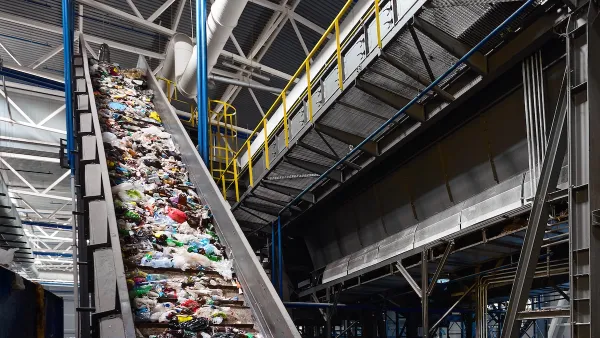
Recycling’s Real Impact: Challenges, Misconceptions, and the Path Forward
Recycling offers modest environmental benefits but faces significant challenges in effectiveness and scalability, requiring systemic changes like reducing plastic production and exploring alternative waste reduction strategies.
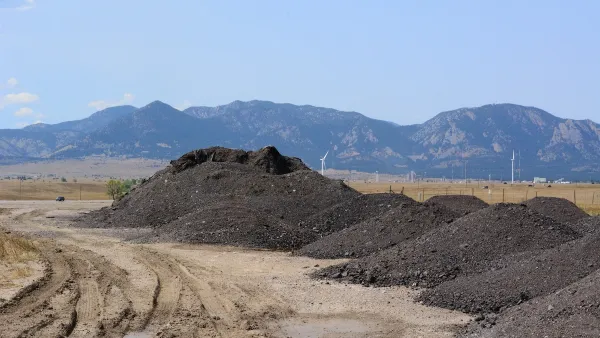
Colorado Ramps Up Rural Recycling Program
The state is creating a framework for building better access to recycling facilities and services for rural residents and businesses.

Planetizen Federal Action Tracker
A weekly monitor of how Trump’s orders and actions are impacting planners and planning in America.

California plans to bury El Niño’s downpour
If the state plays its cards right, it may be able to store a billion acre-feet of El Niño’s water in aquifers.

Desperate measures: Advocates weigh draining Lake Powell to fill Colorado River
Draining the reservoir could reduce evaporation losses by a couple hundred thousand acre-feet.

Los Angeles just elected an urban planner as its mayor
Transportation analysts are optimistic that Raman will be more aggressive in addressing transit issues than Bass.

Mamdani’s pied-à-terre tax survives legal challenge
A panel of judges found that the plaintiffs failed to demonstrate injury as a result of New York City's implementation of the tax.

Eastern Nebraska is running out of electricity
Data centers and electrification are straining eastern Nebraska’s grid, throttling economic development.

FREE Course: Walkable City 1: Why Walkability?
After describing his path towards focusing on walkability as the essence of good planning, Jeff Speck marches through his five principal reasons for making more walkable places.
Reinventing Malls: Planning Alchemy—Turning Gray Fields Into Gold
The course focuses on the opportunities and imperatives that shape reinvention of mall sites.

City of Rosemead
Rutgers University, Edward J. Bloustein School of Planning and Public Policy
One Hundred Miles
University of Michigan School for Environment and Sustainability (SEAS)
Hunter College, City University of New York (CUNY)
The Architects Foundation
City of Cambridge
Montrose County
The Pocatello Development Authority