Chicago's historic landmarks ordinance is being challenged in the courts and is expected to be ruled unconstitutional. Blair Kamin discusses the impact the rule change could have on historic preservation in Chicago and beyond.


"Yet the effort to safeguard this mid-1960s classic is grinding forward rather than speeding ahead. That is a consequence, some preservation advocates contend, of a court challenge that could jeopardize Chicago's 41-year-old landmark ordinance-and the 281 individual landmarks and 51 districts it safeguards, including Frank Lloyd Wright's Robie House, Ludwig Mies van der Rohe's Crown Hall, Louis Sullivan's former Carson Pirie Scott & Co. store on State Street, and Wrigley Field.
In January, the Illinois Appellate Court deemed the law to be unconstitutionally vague. When the Illinois Supreme Court denied the city's appeal of that ruling last Thursday, it sent the case back to the Cook County Circuit Court, where a judge is thought to have little choice but to strike down the law.
The case has jolted historic preservationists around the country, and for good reason."
Read the full story: Turmoil over landmark law making waves in and outside Chicago
Why Protecting Ballpark's Historic Designation is Good for Chicago
A proposal to sell the naming rights of Chicago's Wrigley Field is being seen as a relaxation of the ballpark's historic landmark restrictions and may open the door for city-wide landmark designation challenges, according to this commentary.

Chicago voters approve permanent festival grounds, penalty for vacant property owners
Currently, major summer and fall festivals take over public parks for weeks at a time, drawing criticism from nearby residents
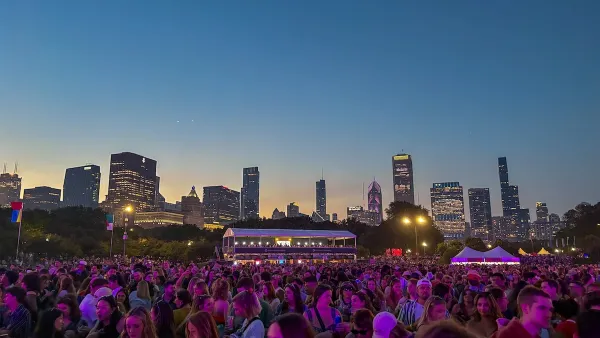
Non-stop party: Chicago voters weigh permanent festival grounds
A stable place for bleachers, stages and drainage may streamline the setup and teardown of large events.

Desperate measures: Advocates weigh draining Lake Powell to fill Colorado River
Draining the reservoir could reduce evaporation losses by a couple hundred thousand acre-feet.

Eastern Nebraska is running out of electricity
Data centers and electrification are straining eastern Nebraska’s grid, throttling economic development.

Malls are becoming the midtowns of the future
Mall and office park redevelopments are a generational opportunity to create new nodes of urbanity.

NYC breaks ground on anti-flooding infrastructure project
New York City's new system will reduce stormwater flows to local sewers by 90%.

One Kentucky town’s secret to affordable housing
The Smoketown Community Land Trust has already built seven affordable homes for community members.

Houston gains petal-shaped cooling infrastructure to make streets more ‘delightful’
The city has installed the pavilions along 15 blocks in Houston.

FREE Course: Walkable City 1: Why Walkability?
After describing his path towards focusing on walkability as the essence of good planning, Jeff Speck marches through his five principal reasons for making more walkable places.
Reinventing Malls: Planning Alchemy—Turning Gray Fields Into Gold
The course focuses on the opportunities and imperatives that shape reinvention of mall sites.

City of Rosemead
Rutgers University, Edward J. Bloustein School of Planning and Public Policy
One Hundred Miles
University of Michigan School for Environment and Sustainability (SEAS)
Hunter College, City University of New York (CUNY)
The Architects Foundation
City of Cambridge
Montrose County
The Pocatello Development Authority