This piece from the New York Times looks at a program in Italy the encourages children to walk to school.


"Each morning, about 450 students travel along 17 school bus routes to 10 elementary schools in this lakeside city at the southern tip of Lake Como. There are zero school buses.
In 2003, to confront the triple threats of childhood obesity, local traffic jams and - most important - a rise in global greenhouse gases abetted by car emissions, an environmental group here proposed a retro-radical concept: children should walk to school.
They set up a piedibus (literally foot-bus in Italian) - a bus route with a driver but no vehicle. Each morning a mix of paid staff members and parental volunteers in fluorescent yellow vests lead lines of walking students along Lecco's twisting streets to the schools' gates, Pied Piper-style, stopping here and there as their flock expands."
Read the full story: Students Give Up Wheels for Their Own Two Feet
Ban on Biking and Walking to School May Be Lifted
A 15-year-old ban on biking and walking to school in Saratoga Springs, New York may be lifted, after one bike-friendly parent challenged the policy.
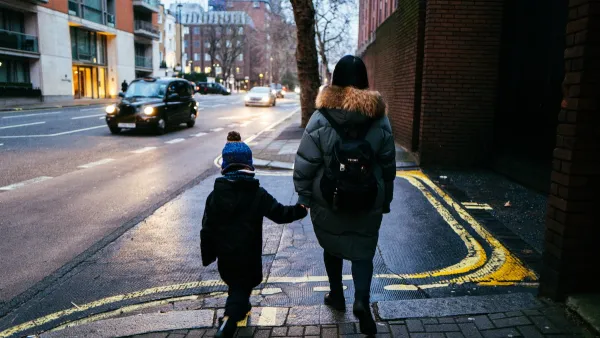
London Low-Emissions Zone Prompts Shift to Active Modes
More children are using active transportation modes to get to school in the wake of a policy that charges drivers to enter a low-emissions zone in central London.
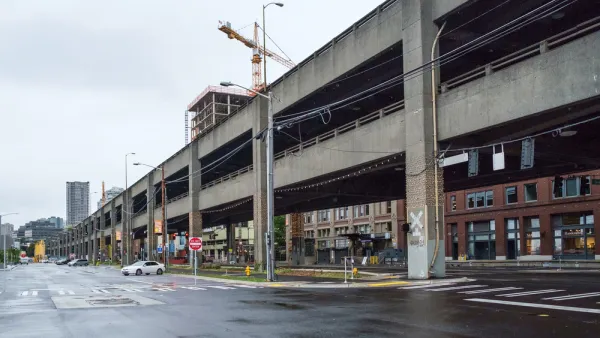
Seattle Scrambles to Handle Upcoming Traffic 'Squeeze'
Dubbed the "Seattle Squeeze," heavier traffic is expected in the new year as the Alaskan Way Viaduct closes and downtown construction projects continue. While the city prepares, activists want to use the opportunity to encourage other modes.

Planetizen Federal Action Tracker
A weekly monitor of how Trump’s orders and actions are impacting planners and planning in America.

Eastern Nebraska is running out of electricity
Data centers and electrification are straining eastern Nebraska’s grid, throttling economic development.

Study reveals best places in the U.S. for cycling, walking
New research from Streetlight Data examines bicycle and pedestrian miles per capita in the 100 largest U.S. cities by population.

DSA members accuse Mamdani of 'abandoning values' over housing redevelopment
New York City's mayor plans to replace about 2,000 units of public housing with private, mixed-income housing.

All sides of BRT debate unhappy with CDOT’s most recent move
The Colorado Department of Transportation is no longer considering center-running bus lanes for Colorado Boulevard.

Massachusetts bogs generate both power, and cranberries
Putting solar panels above farmland is one way Massachusetts is advancing toward its goal of net-zero carbon emissions by 2050.

FREE Course: Walkable City 1: Why Walkability?
After describing his path towards focusing on walkability as the essence of good planning, Jeff Speck marches through his five principal reasons for making more walkable places.
Reinventing Malls: Planning Alchemy—Turning Gray Fields Into Gold
The course focuses on the opportunities and imperatives that shape reinvention of mall sites.

City of Rosemead
Rutgers University, Edward J. Bloustein School of Planning and Public Policy
One Hundred Miles
University of Michigan School for Environment and Sustainability (SEAS)
Hunter College, City University of New York (CUNY)
The Architects Foundation
City of Cambridge
The Pocatello Development Authority
The Urban Renewal Agency of the City of Pocatello