In allowing places to be designed for cars before people, city planners are primarily to blame for creating an "autocentric" America, according to this article.


"For the past six decades, [city planners have] swallowed the premise of the asphalt nation whole.
It's city planners who've long uncritically accepted the notion that cars should be the focus of our urban design, turning the built environment into one big playground for motor vehicles. It's city planners who've allowed draconian parking requirements, rather than intelligent land use, to determine what gets built - a policy that literally puts humans second to their cars.
But don't take my word for it. In his book 'The High Cost of Free Parking,' UCLA urban planning Professor Donald Shoup flatly states:
"'Parking requirements create great harm: They subsidize cars, distort transportation choices, warp urban form, increase housing costs, burden low-income households, debase urban design, damage the economy, and degrade the environment.'"
Read the full story: U.S. urban planning priorities out of whack

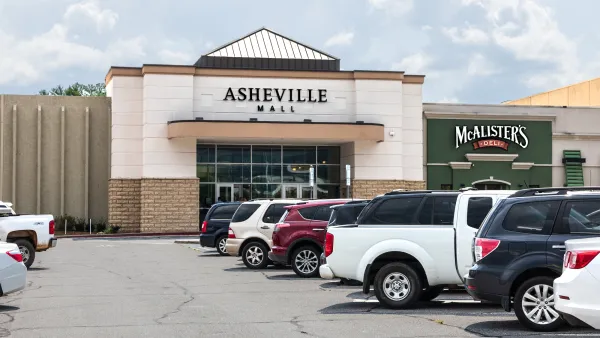
Asheville reconsiders parking minimums as surface parking eats up over a third of downtown real estate
Housing advocates say parking requirements are unnecessary and induce sprawl.

Planetizen’s Top Posts of 2025
The most-read articles on Planetizen in 2025.
August Must-Reads: Top 10 Articles From Last Month
In suburban Houston, cities are scrambling to expand water infrastructure to serve new communities. But can sprawl be part of a workable solution to the housing crisis?

Planetizen Federal Action Tracker
A weekly monitor of how Trump’s orders and actions are impacting planners and planning in America.

‘Going backwards:’ Baltimore mayor, students rally against state's transit funding plan
Maryland's proposed six-year plan provides no funding for Baltimore’s BMORE bus program and reduces its road maintenance funding.
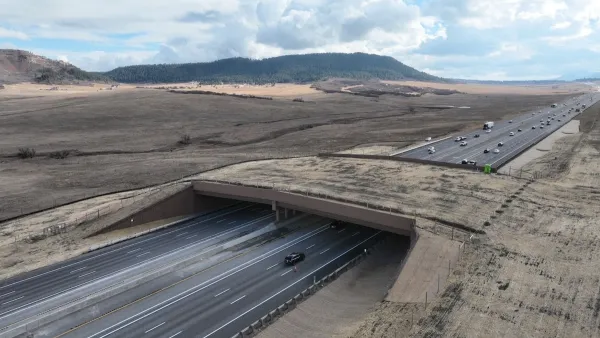
Record-breaking wildlife overpass in Colorado brings 91% reduction in animal collisions
Prior to the overpass, vehicles were hitting one deer per day on Colorado’s Interstate 25.

Mamdani sent nearly 6,000 pied-à-terre tax warnings to homes that didn’t qualify
A judge has ordered the administration to cancel thousands of pied-à-terre tax notices after it sent 35% of them erroneously.

Detroit to transform waterfront with $2.2 billion investment
Developers will convert about 18 acres of unused parking lot space into civic spaces.

‘Going backwards:’ Baltimore mayor, students rally against state's transit funding plan
Maryland's proposed six-year plan provides no funding for Baltimore’s BMORE bus program and reduces its road maintenance funding.

FREE Course: Walkable City 1: Why Walkability?
After describing his path towards focusing on walkability as the essence of good planning, Jeff Speck marches through his five principal reasons for making more walkable places.
Reinventing Malls: Planning Alchemy—Turning Gray Fields Into Gold
The course focuses on the opportunities and imperatives that shape reinvention of mall sites.

City of Thousand Oaks
City of Wisconsin Rapids
Harvard University Graduate School of Design
The Architects Foundation
University of Cincinnati Online
Northern Illinois Transit Authority (NITA)
The Pocatello Development Authority
The Urban Renewal Agency of the City of Pocatello