In one part of downtown Syracuse, motorists are now forced to park by backing into diagonal spaces.


"The city is moving toward 'back-in angle' parking rather than 'nose-first' diagonal parking or parallel parking for several reasons. Driscoll says the 'back-in' method makes it easier for a motorist to pull out of a parking space safely. Studies in other cities have found a reduction in collisions with bicycles, pedestrians and other vehicles. And backing in is safer for children because kids who exit a backed-in car are more likely to move toward the sidewalk than into traffic.
The diagonal system also allows room for more spaces than parallel parking. The city added eight spaces to two blocks of Erie Boulevard East.
Motorists who encountered the new stripes Friday said they appreciated the extra spaces, but had less favorable reviews for the back-in method...calling the reverse-angle parking 'ridiculous' and 'absurd.' Several drivers either overlooked or ignored the prominent parking signs and swung their cars around to pull into the spaces nose-first."
Read the full story: Getting into some parking spots now takes a bit more technique
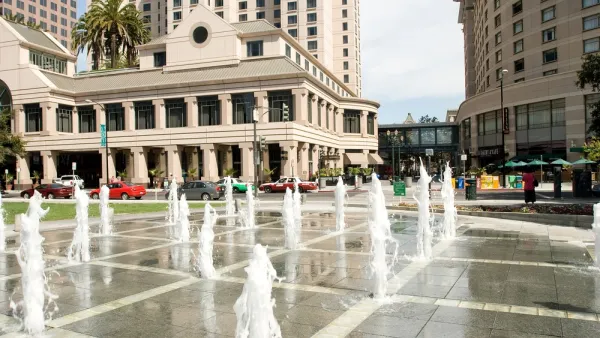
For Lack of Free Parking, Downtown San Jose Loses a Grocery Store
Why isn't there a place for a major grocery store brand in the downtown of one of the most economically active cities in the country?
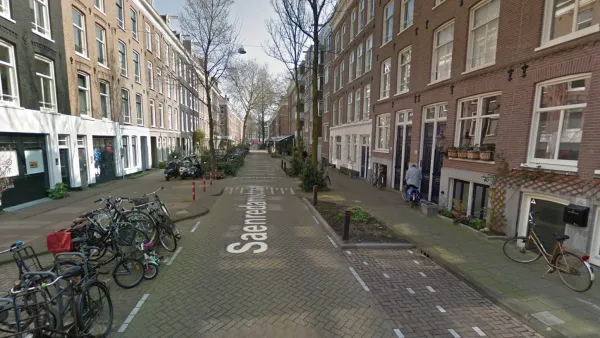
Watch: How to Remove Thousands of Parking Spaces
What the city of Amsterdam will gain by removing cars from on-street parking space.
Better Downtowns May Not Need Cars, But They Will Need Parking
Downtowns can be designed to both reduce driving and boost the economy. But they're still going to need parking, according to urban designers George Crandall and Don Arambula.

Planetizen Federal Action Tracker
A weekly monitor of how Trump’s orders and actions are impacting planners and planning in America.

California plans to bury El Niño’s downpour
If the state plays its cards right, it may be able to store a billion acre-feet of El Niño’s water in aquifers.

Desperate measures: Advocates weigh draining Lake Powell to fill Colorado River
Draining the reservoir could reduce evaporation losses by a couple hundred thousand acre-feet.

Los Angeles just elected an urban planner as its mayor
Transportation analysts are optimistic that Raman will be more aggressive in addressing transit issues than Bass.

Mamdani’s pied-à-terre tax survives legal challenge
A panel of judges found that the plaintiffs failed to demonstrate injury as a result of New York City's implementation of the tax.

Eastern Nebraska is running out of electricity
Data centers and electrification are straining eastern Nebraska’s grid, throttling economic development.

FREE Course: Walkable City 1: Why Walkability?
After describing his path towards focusing on walkability as the essence of good planning, Jeff Speck marches through his five principal reasons for making more walkable places.
Reinventing Malls: Planning Alchemy—Turning Gray Fields Into Gold
The course focuses on the opportunities and imperatives that shape reinvention of mall sites.

City of Rosemead
Rutgers University, Edward J. Bloustein School of Planning and Public Policy
One Hundred Miles
University of Michigan School for Environment and Sustainability (SEAS)
Hunter College, City University of New York (CUNY)
The Architects Foundation
City of Cambridge
Montrose County
The Pocatello Development Authority