Brooklyn’s Ocean Parkway is one of America’s most 'elegant' roads. Designed by landscape architects Frederick Law Olmsted and Calvert Vaux to replicate the grand European Boulevards; opened in 1876, it was designated a landmark by NYC 100 years later


"Elegant and sketchy, welcoming and insular, the striated band of roadway, trees and people called Ocean Parkway both reflects Brooklyn and divides it with a thick green line. It was designed about a century and a half ago as a place to promenade, to socialize, to pleasure-drive or to settle, on a street that looks like a park. The architects Frederick Law Olmsted and Calvert Vaux were inspired by the grand tree-lined boulevards of Europe, like Avenue Foch in Paris and Unter den Linden in Berlin.
Elizabeth Macdonald, an associate professor at the University of California at Berkeley who has written extensively about Ocean Parkway, noted that Olmsted and Vaux imagined a huge system of parks connected by parkways. The two served different purposes: A park was for reflection, and a parkway was for recreation. Ocean Parkway was completed in 1876. The first attractions were roadhouses - places to rest and have a drink - for the pleasure-strollers and those headed to or from the racetracks that once stood in the area. In 1975, the parkway was designated a landmark by the city."
Read the full story: A Tree-Lined Boulevard That’s a Park and a Living Room

Advocates Push for Tearing Down Freeway Through Olmsted Corridor
Buffalo's Kensington Expressway cut the Humbolt Parkway neighborhood and its Frederick Law Olmsted-designed corridor in half in 1958. Activists are pushing the state to consider tearing it down and replacing it with a pedestrian-friendly boulevard.
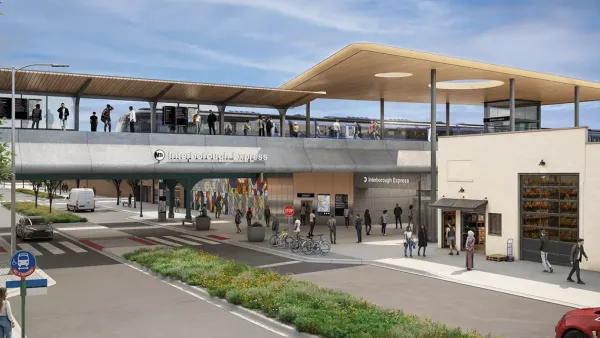
NYC releases new renderings for $5.5 billion Interborough Express
The slated stations will have a modern look, enhanced lighting and improved audio announcements.
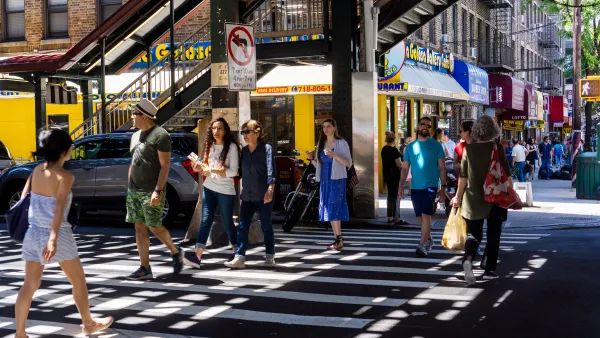
NYC needs 700,000 new homes to resolve housing crisis, report states
The report gave every neighborhood a non-binding development target.

Planetizen Federal Action Tracker
A weekly monitor of how Trump’s orders and actions are impacting planners and planning in America.

California plans to bury El Niño’s downpour
If the state plays its cards right, it may be able to store a billion acre-feet of El Niño’s water in aquifers.

Desperate measures: Advocates weigh draining Lake Powell to fill Colorado River
Draining the reservoir could reduce evaporation losses by a couple hundred thousand acre-feet.

California city breaks ground on transit connector
The project includes three mobility hubs and a pedestrian bridge.

After public outcry, Massachusetts city releases housing development tracker
Cambridge’s tracker currently shows 250 housing projects in various stages of development.

40 years after approval, Chicago breaks ground on new park
The park honors Jean Baptiste Point du Sable, the city’s first permanent non-native settler.

FREE Course: Walkable City 1: Why Walkability?
After describing his path towards focusing on walkability as the essence of good planning, Jeff Speck marches through his five principal reasons for making more walkable places.
Reinventing Malls: Planning Alchemy—Turning Gray Fields Into Gold
The course focuses on the opportunities and imperatives that shape reinvention of mall sites.

City of Rosemead
Rutgers University, Edward J. Bloustein School of Planning and Public Policy
One Hundred Miles
Hunter College, City University of New York (CUNY)
The Architects Foundation
University of Cincinnati Online
City of Cambridge
Montrose County
The Pocatello Development Authority