'Pay as you drive' insurance will soon be a reality in California, surviving the state senate as a voluntary program that environmental groups say will encourage people to drive less by saving them money on their car insurance.


"The program, dubbed "pay as you drive" in which drivers document their mileage and pay accordingly, will encourage motorists to drive less, saving fuel and reducing carbon emissions, environmental groups said. In doing so, they also would lower their insurance premiums."
The legislation, AB 2800 (Huffman), was amended earlier this month to drop a controversial clause of tracking miles through a global positioning device. The original bill drew criticism from Consumer Watchdog, a Santa Monica-based nonprofit, which said the practice would constitute an invasion of privacy. While the legislation died, the proposal will go forward with a plan from Insurance Commissioner Steve Poizner. Consumer groups feared privacy invasion from tracking devices, so mileage will be verified from odometer readings, not GPS.The regulations will be voluntary and are expected to take effect by fall 2009.
While insurance companies already take mileage into account when setting rates, pay-as-you-drive links premiums more closely with the actual number of miles driven. Under the new regulations, consumers could verify mileage by odometer readings, repair records or a technological device used to collect mileage data. Poizner made it clear, however, that insurance companies could not require tracking software."
From Insurance Commissioner's Press Release:
"The Environmental Defense Fund estimates that if 30% of Californians participate in this voluntary coverage, California could avoid 55 million tons of CO2 between 2009 and 2020, which is the equivalent of taking 10 million cars off the road."
Thanks to Gladwyn d'Souza?
Read the full story: ‘Pay as you drive’ rolls forward
Answers on the Nation's First VMT Fee Law
With Oregon set to implement their vehicle-miles-traveled (VMT) fee program, Streetsblog's Tanya Snyder provides answers to ten questions, including the privacy challenge, that she posed to ODOT’s Jim Whitty, architect of the program.
LA Metro is paying Angelenos up to $600 to leave their car at home
Metro will pay around 2,000 households to participate in a program designed to shift travel modes away from private car trips to transit, biking, walking and shared mobility.
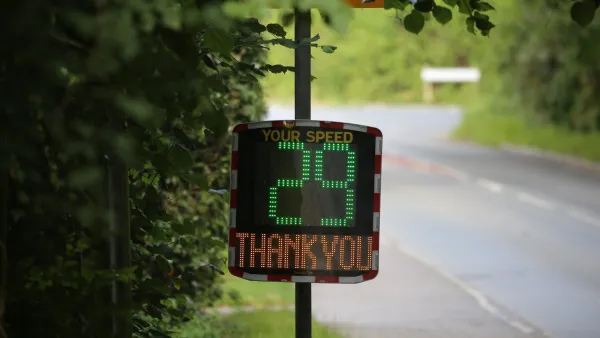
Austin road sign compliments safe drivers
An electronic display praises drivers who stay under the speed limit with personalized messages.

Planetizen Federal Action Tracker
A weekly monitor of how Trump’s orders and actions are impacting planners and planning in America.

California plans to bury El Niño’s downpour
If the state plays its cards right, it may be able to store a billion acre-feet of El Niño’s water in aquifers.

Desperate measures: Advocates weigh draining Lake Powell to fill Colorado River
Draining the reservoir could reduce evaporation losses by a couple hundred thousand acre-feet.

Chicago voters approve permanent festival grounds, penalty for vacant property owners
Currently, major summer and fall festivals take over public parks for weeks at a time, drawing criticism from nearby residents

NYC votes to cut outdoor dining red tape, speed up permitting
New York City also voted to allow the Department of Transportation to begin work on urgent projects before notifying elected officials.

California appears to reject Prop. 45
The proposition would have expanded the projects that qualify for a streamlined environmental review, effectively paring down the California Environmental Quality Act.

FREE Course: Walkable City 1: Why Walkability?
After describing his path towards focusing on walkability as the essence of good planning, Jeff Speck marches through his five principal reasons for making more walkable places.
Reinventing Malls: Planning Alchemy—Turning Gray Fields Into Gold
The course focuses on the opportunities and imperatives that shape reinvention of mall sites.

City of Rosemead
Rutgers University, Edward J. Bloustein School of Planning and Public Policy
One Hundred Miles
Hunter College, City University of New York (CUNY)
The Architects Foundation
University of Cincinnati Online
City of Cambridge
Montrose County
The Pocatello Development Authority