States are helping homeowners who want to have a more eco-friendly lifestyle by overturning homeowner association regulations that ban solar panels and wind turbines.


"States eager to promote renewable energy are increasingly passing laws that allow homeowners to overcome local opposition to home solar panels and wind turbines.
Since 2005, eight states - including four last year - have enacted laws to abolish stringent rules imposed by some homeowners associations and local agencies on residents who want to power their homes with the sun or wind. Maryland Gov. Martin O'Malley signed such a bill two weeks ago. Final action is near in Virginia and Florida.
Some new laws say homeowners groups can't ban such technology. Others say local governments can't enforce rules that significantly raise the cost of installing eco-friendly energy systems.
"If you're going to have local governments and condo associations saying, 'Solar panels are ugly,' that's a real stumbling block," says state Democratic Rep. Karen May, a sponsor of a "solar rights bill" pending in Illinois."
Read the full story: States remove local barriers to eco-friendly homes

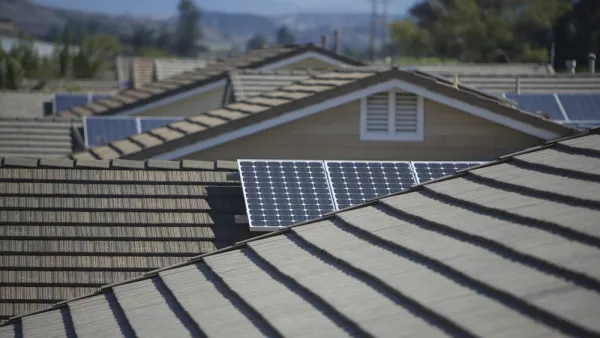
California to Require Solar on New Residential Buildings
The California Energy Commission will decide on new energy standards for residential construction this week.
Proposed Law Would Require Solar Panels on All New Home Construction in California
So far four cities in California require solar panels on all new residential construction, with San Francisco as the most populous example. A proposed law would expand that requirement to the rest of the state.
Trump administration unlawfully slashed $7 billion in clean energy grants, judge rules
The Environmental Protection Agency ended the Solar For All program, which provided the grants, after President Donald Trump’s inauguration.

Planetizen Federal Action Tracker
A weekly monitor of how Trump’s orders and actions are impacting planners and planning in America.

Data reveals that NYC’s bet on congestion pricing has paid off
After almost two years of the program, reports show positive impacts on traffic and air quality and no disruptions to parking.

HUD modernizes 50-year-old manufactured housing framework
The Next Generation Manufactured Housing Action Plan establishes new energy-efficiency standards for manufactured homes, and new guidelines for anchoring them.

Chicago city vehicles are on the hunt for illegally-parked cars
Cameras on the vehicles can automatically issue tickets to drivers who park their cars in bus or bike lanes.

Small single-family homes are illegal in most of MA. Voters can change that
Most land zoned for single-family housing in Massachusetts requires at least 40,000 square feet of land per house.

Public steps inside U.S.’s first battery-powered train
Metra’s groundbreaking train feature modern seats and a futuristic battery car.

FREE Course: Walkable City 1: Why Walkability?
After describing his path towards focusing on walkability as the essence of good planning, Jeff Speck marches through his five principal reasons for making more walkable places.
Reinventing Malls: Planning Alchemy—Turning Gray Fields Into Gold
The course focuses on the opportunities and imperatives that shape reinvention of mall sites.

One Hundred Miles
County of Mendocino
planning NEXT
The Architects Foundation
University of Cincinnati Online
Montrose County
Northern Illinois Transit Authority (NITA)
The Pocatello Development Authority