So far four cities in California require solar panels on all new residential construction, with San Francisco as the most populous example. A proposed law would expand that requirement to the rest of the state.


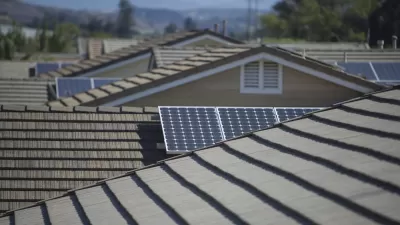
"Newly sworn-in state Sen. Scott Wiener, D-San Francisco, plans to introduce legislation Monday requiring all new construction in the state to include solar panels," reports Melody Gutierrez.
The proposed law would expand current state requirements that new building "have at least 15 percent of the roof clear of obstructions and shade" to be ready for solar panels to be added at a later date, according to another article on the proposed law by Kate Wheeling.
The state bill builds on a similar ordinance in San Francisco, authored by Senator Wiener while he was a San Francisco County Supervisor. "San Francisco was the first major city in the country to require that solar panels be installed on new buildings and homes," according to Gutierrez. Though San Francisco is one of for cities around the state to require solar panels on new construction (Lancaster, Santa Monica, and Sebastopol are the others), the bill is expected to have a difficult path to adoption at the state level.
FULL STORY: Scott Wiener models state solar bill on S.F. law

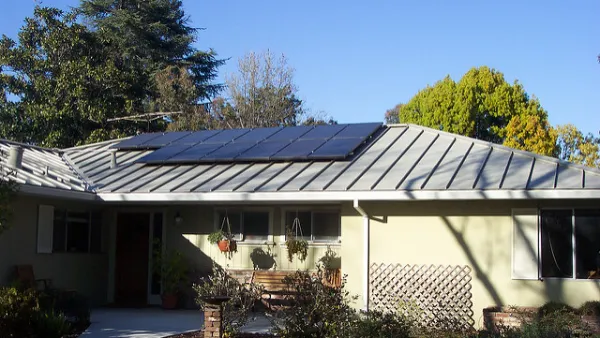
Details of the Golden State's Residential Solar Requirement
San Francisco Chronicle energy reporter David R. Baker sheds some light on the nation's first state building code requiring that solar panels be included in new home construction, adopted by the California Energy Commission on May 9.
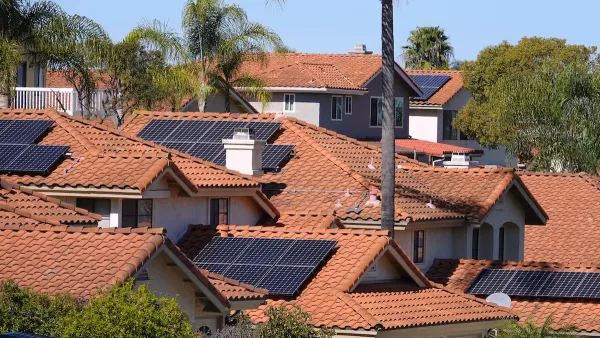
California Leads in Solar Rooftops
A combination of state and local incentives and building code mandates has helped California far outpace other states in residential rooftop solar permits.
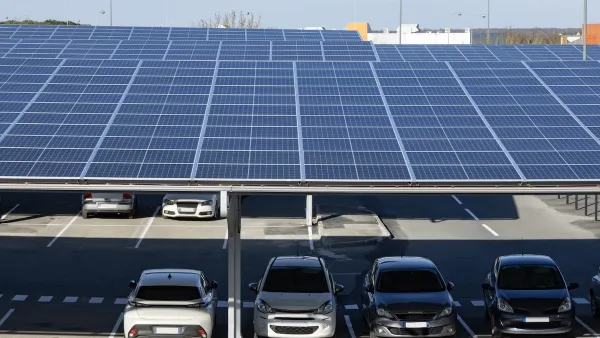
Commercial Buildings, Parking Lots Offer Significant Potential for Solar Energy
Massive swaths of flat rooftops, garages, and surface parking lots go underutilized. They could be producing renewable energy.

Planetizen Federal Action Tracker
A weekly monitor of how Trump’s orders and actions are impacting planners and planning in America.

The state-sanctioned urbicide of Austin
People don’t kill cities. Freeways do.

US to reduce Colorado River water deliveries to Mexico
A new Colorado Treaty amendment reduces Mexico’s Colorado River water allocation by 250,000 acre feet.

5 New England states march closer to 800 megawatt wind energy project
Securing federal approval for the project may be complicated under the Trump administration, which has historically been hostile towards domestic wind power.

Baltimore to break ground on $50 million Transit Priority Project
The project will bring faster bus trips, safer streets and better bike connections to Baltimore.

Airbnb launches $250 million 'last-dollar financing' housing accelerator, makes first investment in Austin
The company will put $6.4 million towards affordable housing development in Texas’ capital.

FREE Course: Walkable City 1: Why Walkability?
After describing his path towards focusing on walkability as the essence of good planning, Jeff Speck marches through his five principal reasons for making more walkable places.
Reinventing Malls: Planning Alchemy—Turning Gray Fields Into Gold
The course focuses on the opportunities and imperatives that shape reinvention of mall sites.

Eagle County Government
Harvard University Graduate School of Design
Nashville Planning Department
The Architects Foundation
University of Cincinnati Online
The Pocatello Development Authority
The Urban Renewal Agency of the City of Pocatello
Journal of the American Planning Association