A bill introduced in Sacramento could pave the way for Los Angeles County to raise $400 million dollars a year for public transit from motorists -- who'd pay more for gas or vehicle registration.


"Motorists in Los Angeles County could end up paying an extra 9 cents per gallon at the gas pump, or an additional $90 on their vehicle registration, under proposals aimed at getting them to help fight global warming.
Voters would be able to decide whether to approve a "climate change mitigation and adaptation fee" under legislation being considered by state lawmakers and endorsed by the board of the Los Angeles County Metropolitan Transportation Authority.
The money would fund improvements to mass transit and programs to relieve traffic congestion at a time when transportation dollars from Washington and Sacramento are hard to come by.
"At this point the people of the Los Angeles region have just had it when it comes to traffic and air quality," said Assemblyman Mike Feuer (D-Los Angeles), author of the legislation, AB2558."
Read the full story: Driver fee would help fight warming
Transit, or Schools?
Atlanta school leaders consider renegotiating a Tax Allocation District (TAD) agreement that was set up to help fund projects such as the Beltline, a 22-mile loop of transit, trails, parks and development around the city.
Half-a-Penny for Your Transit?
After being signed by California Governor Arnold Schwarzenegger, a half-cent sales tax increase will appear on the November ballot in Los Angeles County, where it would create a fund for public transit projects.
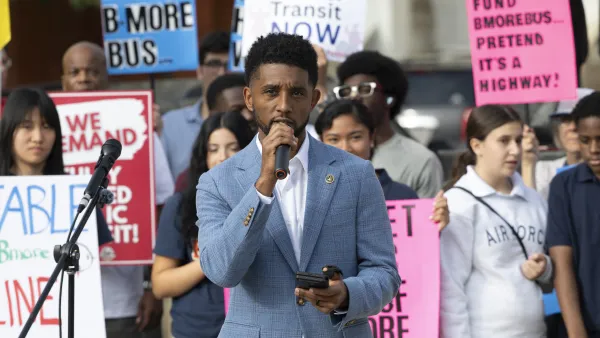
‘Going backwards:’ Baltimore mayor, students rally against state's transit funding plan
Maryland's proposed six-year plan provides no funding for Baltimore’s BMORE bus program and reduces its road maintenance funding.

Planetizen Federal Action Tracker
A weekly monitor of how Trump’s orders and actions are impacting planners and planning in America.

California plans to bury El Niño’s downpour
If the state plays its cards right, it may be able to store a billion acre-feet of El Niño’s water in aquifers.

Desperate measures: Advocates weigh draining Lake Powell to fill Colorado River
Draining the reservoir could reduce evaporation losses by a couple hundred thousand acre-feet.

Mamdani’s pied-à-terre tax survives legal challenge
A panel of judges found that the plaintiffs failed to demonstrate injury as a result of New York City's implementation of the tax.

Eastern Nebraska is running out of electricity
Data centers and electrification are straining eastern Nebraska’s grid, throttling economic development.

Seattle passes record-breaking transit services expansion
Proposition 1 will double the city’s transit tax to add 95,000 more bus trips and preserve 180,000 bus trips annually.

FREE Course: Walkable City 1: Why Walkability?
After describing his path towards focusing on walkability as the essence of good planning, Jeff Speck marches through his five principal reasons for making more walkable places.
Reinventing Malls: Planning Alchemy—Turning Gray Fields Into Gold
The course focuses on the opportunities and imperatives that shape reinvention of mall sites.

City of Rosemead
Rutgers University, Edward J. Bloustein School of Planning and Public Policy
One Hundred Miles
University of Michigan School for Environment and Sustainability (SEAS)
Hunter College, City University of New York (CUNY)
The Architects Foundation
City of Cambridge
Montrose County
The Pocatello Development Authority